
If you're an Indian student planning to study in Canada in 2026 or 2027, here is the honest truth upfront: Canada is still open, the degrees are still world-class, and the path to a Post-Graduation Work Permit and PR still exists. But the rules of the game have completely changed. The fast-track SDS route is gone, the money you must show has more than doubled, there's now a hard cap on how many students Canada accepts, and refusal rates for Indian applicants have hit record highs.
Students who apply with outdated information get refused. Students who understand the new system and prepare their file accordingly still get approved every week. This guide covers every rule that changed, what it means for you, and exactly how to build an application that survives the new scrutiny.
Quick Summary: What Changed for 2026
| Rule | Before | Now (2026) |
|---|---|---|
| Study permit cap | No cap (pre-2024) | 408,000 total permits; only 155,000 for new students |
| SDS fast-track | 20-day processing for Indians | Discontinued (8 Nov 2024) everyone applies via Regular Stream |
| Processing time | ~20 days (SDS) | Approximately 8–12 weeks |
| Proof of living funds | CAD 10,000 (pre-2024) | CAD 22,895/year + first-year tuition + travel |
| PAL/TAL requirement | Did not exist | Required for UG & diploma; Master's/PhD at public universities exempt from 1 Jan 2026 |
| PGWP language rule | No language test needed | CLB 7 (IELTS 6.0 each band) for degree holders; CLB 5 for diploma holders |
| Spouse open work permit | Widely available | Restricted to spouses of students in select graduate/professional programs |
Now let's break down each change in detail.
1. The Study Permit Cap: Only 155,000 Seats for New Students
The single biggest change is that Canada now runs a capped system. For 2026, the federal government has set a limit of 408,000 study permits in total but the number that matters to you is 155,000, because that's the allocation for students arriving for the first time. The rest are extensions for students already inside Canada.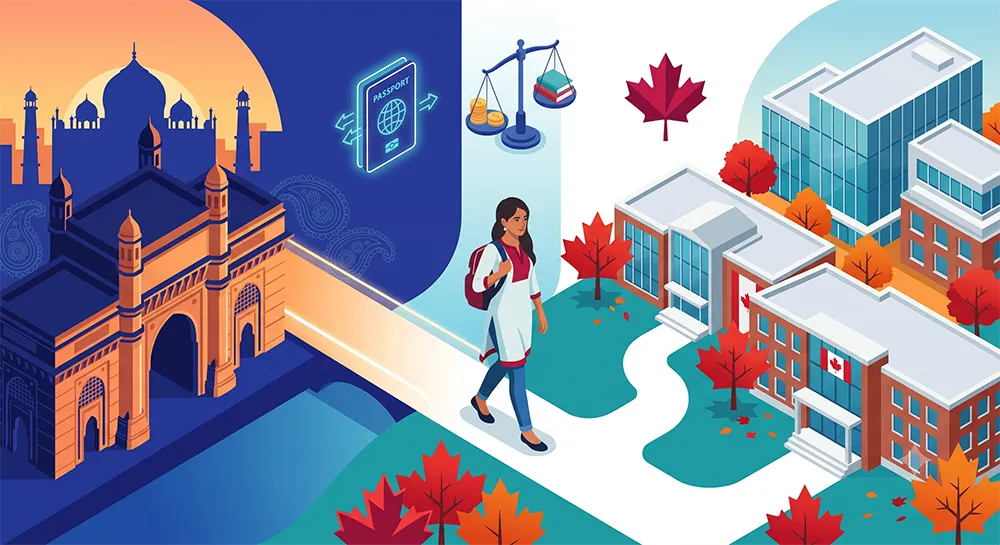
To put that in perspective: Canada issued 485,000 permits in 2024 and 437,000 in 2025. The pool is shrinking every year, and the government has publicly committed to bringing temporary residents below 5% of Canada's population by end of 2027 meaning these caps are policy, not a temporary measure.
What this means for you: Indian students have historically been Canada's largest source of international students, so a smaller pool hits Indian applicants hardest. Competition per seat is real now. Applying early in the intake cycle, choosing a public DLI with available allocation, and submitting a complete, error-free file the first time matters more than it ever has.
2. SDS Is Dead: Everyone Now Applies Through the Regular Stream
The Student Direct Stream the fast-track that gave Indian students visa decisions in about 20 business days was discontinued on 8 November 2024. Some agents in Punjab still advertise "SDS processing." That is false, and it's an easy way to spot an agent working on outdated knowledge.
All Indian applicants now go through the Regular Stream:
- Typical processing time is approximately 8–12 weeks from biometrics
- You submit the same strength of financial evidence, but officers now assess every file individually there is no simplified checklist route anymore
- One positive exception: PhD applicants applying from outside Canada now get priority processing of around 14 days
What this means for you: the days of applying in June for a September intake are over. For September 2026/2027 intakes, your study permit file should be submitted by April–May at the latest. Build a reverse timeline: offer letter → PAL (if needed) → GIC + tuition payment → medical → biometrics → 12 weeks of buffer.
3. Proof of Funds: CAD 22,895 Is the New Baseline
The financial requirement has more than doubled from the old CAD 10,000 standard. For 2026 applications you must show:
- CAD 22,895 for one year of living expenses (single applicant) separate from tuition
- Full first-year tuition (paid or held in verifiable funds)
- Return travel costs
For most students, the cleanest way to show living funds remains the Guaranteed Investment Certificate (GIC) of CAD 22,895 through banks like ICICI Canada, Scotiabank, or SBI Canada. (We've covered the full process in our GIC account guide.)
Here's the part most students miss: refusals in this category usually aren't about lacking money they're about documentation. IRCC officers flag:
- Sudden large deposits appearing in accounts just before the application, with no explanation of source
- Bank balances that don't show 6+ months of stable history
- Mismatch between the sponsor's declared income and the funds shown
- Education loan letters that don't clearly state sanctioned (not just eligible) amounts
What this means for you: your "funds story" must be a story where the money came from, why it's sufficient, and paperwork proving every step. A CA certificate, ITRs of sponsors, loan sanction letters, and a source-of-funds affidavit turn the same money from a refusal into an approval.
4. PAL/TAL: The New Gatekeeper Document (and Who's Exempt)
Since 2024, most study permit applications must include a Provincial Attestation Letter (PAL) or Territorial Attestation Letter (TAL) a document proving your seat counts within your province's quota. Your college/university obtains this after you accept the offer and (usually) pay a deposit.
The major update effective 1 January 2026: Master's and PhD students at public universities are exempt from the PAL requirement and from the national cap. This is a deliberate policy choice Canada is prioritising graduate students.
| Program type | PAL/TAL needed in 2026? |
|---|---|
| Bachelor's degree | Yes |
| College diploma / PG diploma | Yes |
| Master's at public university | No (exempt from Jan 2026) |
| PhD at public university | No + 14-day priority processing |
| Private college programs | Yes (and PGWP risk see below) |
What this means for you: if you hold a bachelor's degree with decent marks, a Master's at a public university is now the strongest visa route to Canada no PAL, no cap, faster processing, and full PGWP rights. If you're applying for a diploma, factor PAL wait time into your timeline and confirm your college actually has allocation left for your intake.
5. Refusal Rates Have Exploded Here's the Honest Number
This is the statistic every Indian student needs to see before applying: the refusal rate for Indian undergraduate study permit applications reached approximately 74% in August 2025, compared to around 32% in August 2023.
Read that again. Roughly 3 out of 4 Indian undergraduate applications were being refused. IRCC has tightened assessment across the board: stricter study permit checks, deeper verification of admission letters to combat fraud, harder scrutiny of generic SOPs and "random" course selections that don't match the student's background.
The most common refusal grounds remain:
- "I am not satisfied you will leave Canada" weak home ties / immigration-intent concerns
- Insufficient or poorly documented funds (see section 3)
- Study plan doesn't make sense course choice that doesn't logically follow your academics or career
- Generic, copy-paste SOP IRCC is actively flagging template SOPs
- Unexplained study gaps without documentation
What this means for you: the profile-to-program match is now the whole game. A B.Com graduate applying for a random 1-year hospitality diploma at a private college is a refusal waiting to happen. The same student applying for a PG diploma in accounting or a public-university business program, with an SOP explaining the progression, is approvable. If you've already been refused, get your CAIPS/GCMS notes before reapplying the officer's real reasons are written there, and fixing the actual objection is how refusal cases get approved the second time. (This is exactly the work behind the refusal-case approvals on our success stories page.)
6. PGWP New Rules: Check Before You Choose Your Course, Not After
The Post-Graduation Work Permit the reason most Indian students choose Canada now has eligibility conditions that must be checked before you even apply for your study permit:
- Language requirement: PGWP applicants must now submit a valid language test CLB 7 (IELTS General 6.0 in each band) for university degree holders, CLB 5 for college diploma holders
- Field-of-study requirement: for many college programs, only courses linked to recognised labour shortages remain PGWP-eligible (check your program's CIP code see our full PGWP-eligible programs with CIP codes guide)
- Institution type: graduates of public DLIs retain access to up to 3-year PGWPs; private college graduates face severe restrictions and in most cases should assume no PGWP
- IRCC's own guidance now explicitly warns students to confirm PGWP eligibility of their DLI and program before submitting the study permit applicationf
What this means for you: never choose a college by fees alone. A cheap private college that leaves you with no work permit after graduation is the most expensive mistake in this industry. Verify: (1) public DLI, (2) PGWP-eligible program/CIP code, (3) your realistic IELTS/CELPIP level for the PGWP language rule.
7. Spouse Open Work Permits: Heavily Restricted
The Spousal Open Work Permit (SOWP), once a standard part of the "family moves together" plan, is now limited. Spouses of most college diploma and undergraduate students are no longer eligible; SOWP access is now largely restricted to spouses of students in longer graduate programs and select professional degrees.
What this means for you: if a spouse's ability to work in Canada is central to your family's financial plan, program selection must be made with SOWP rules in mind usually pointing again toward Master's programs at public universities. Get this checked before choosing a course, not after landing.
8. Your 2026 Application Checklist (The New-Rules Version)
- Choose program strategically: public DLI → PGWP-eligible CIP code → matches your academic background → (if applicable) SOWP-eligible level
- Secure offer letter early 10–12 months before intake
- PAL: confirm your institution's provincial allocation (skip if Master's/PhD at public university)
- Funds file: GIC CAD 22,895 + first-year tuition receipt + 6-month bank history + source-of-funds documentation + sponsor ITRs/CA certificate
- SOP: specific, personal, program-justified never a template
- Study gap/refusal documentation if applicable (work proof, gap justification, GCMS-informed response to past refusal)
- Medical with an IRCC panel physician
- Submit 4–6 months before intake; biometrics immediately after
- Track processing (8–12 week baseline) and keep your college informed
Is Canada Still Worth It in 2026? Our Honest Answer
Yes for the right profile, prepared the right way. Permanent residence admissions remain steady at 380,000 per year through 2028, with the economic class growing meaning the study → PGWP → Express Entry pathway still functions for students who choose PGWP-eligible programs and build strong language scores. What's gone is the era when any course at any college was a reliable route to Canada. The new system rewards genuine students with coherent plans and punishes shortcuts.
That is, frankly, the system we've always prepared students for. Whether you have a study gap, a previous refusal, or IELTS 6.0 bands the difference between approval and refusal in 2026 is file quality, not luck.
Not sure where your profile stands under the new rules? Get a free, honest eligibility check with Maya, or WhatsApp our government-registered counsellors we'll tell you your real chances before you spend a rupee.
FAQs: Canada Study Visa New Rules 2026
Q1. Is SDS still available for Indian students in 2026?
No. The Student Direct Stream was discontinued on 8 November 2024. All Indian students now apply through the Regular Stream with processing of roughly 8–12 weeks. Any agent promising "SDS processing" is working on outdated information.
Q2. How much money do I need to show for a Canada study permit in 2026?
CAD 22,895 for one year of living costs (typically via GIC), plus your full first-year tuition, plus travel costs. Documentation quality matters as much as the amount sudden unexplained deposits are a leading refusal trigger.
Q3. Do Master's students need a PAL in 2026?
No. From 1 January 2026, Master's and PhD students at public universities are exempt from the PAL requirement and the national cap. Undergraduate and diploma applicants still need a PAL.
Q4. What is the Canada study visa refusal rate for Indians?
Indian undergraduate refusal rates reached approximately 74% in August 2025 (up from ~32% in August 2023). Graduate applicants at public universities fare significantly better. Strong documentation and program-profile match are now essential.
Q5. Can my spouse get an open work permit if I study in Canada?
Only in limited cases now mainly spouses of students in eligible graduate and professional programs. Spouses of most diploma and bachelor's students no longer qualify.
Q6. Is PGWP still available after a diploma?
Yes, if the program is at a public DLI and meets the field-of-study (CIP code) requirements and you'll need CLB 5 (for diplomas) or CLB 7 (for degrees) on a language test when applying for the PGWP. Private college graduates face heavy restrictions.
Q7. When should I apply for the September 2027 intake?
Start shortlisting by August–September 2026, secure offers by December–January, and file your study permit by March–April 2027. Under the capped, 8–12-week system, late applications are the #1 avoidable mistake.