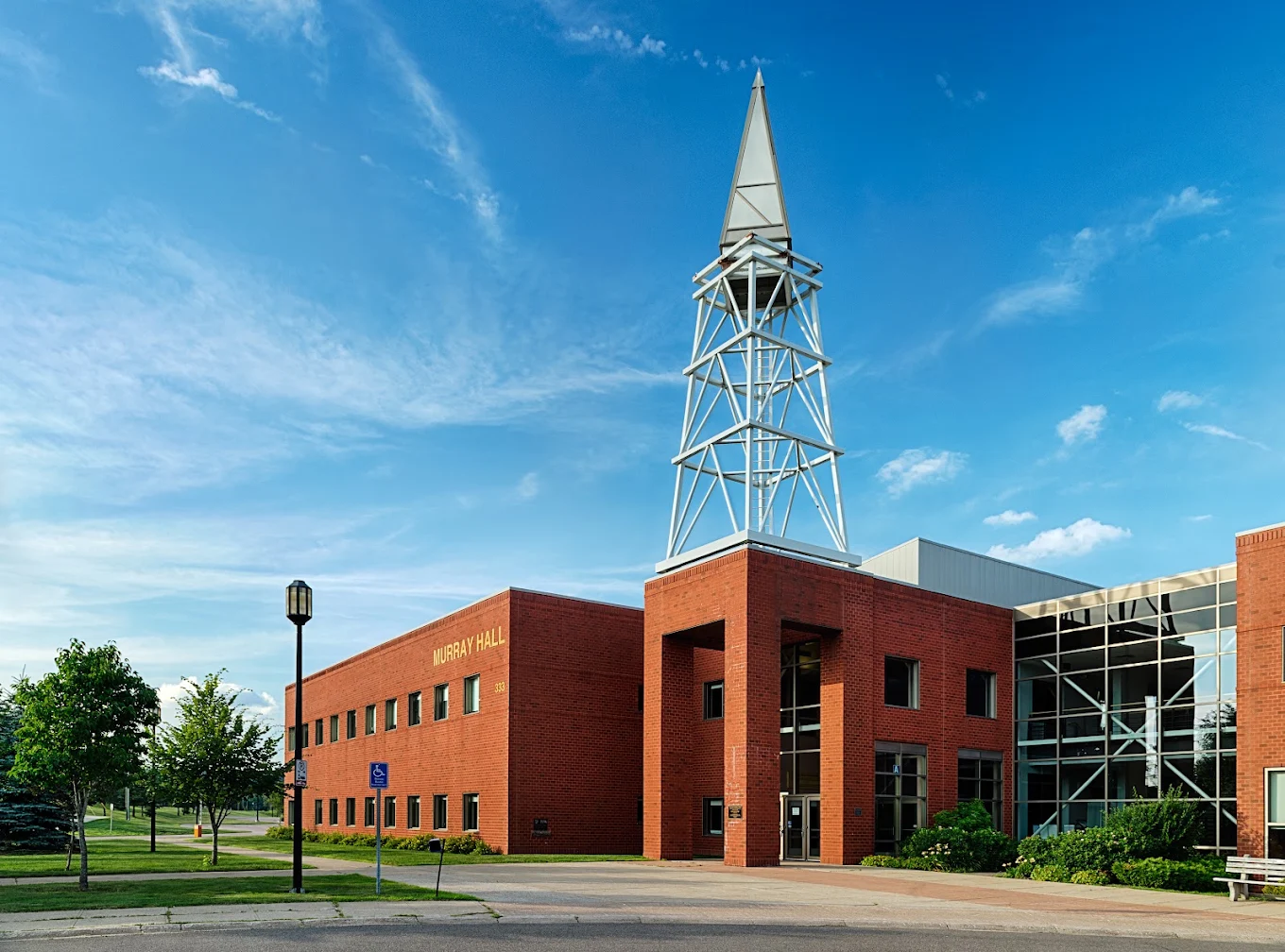

Start with a correction, because it matters. Crandall University is in Moncton, New Brunswick, on Canada’s Atlantic coast. At least one widely read study abroad site describes it as a private university based in Montreal, Quebec. That is a different city in a different province, more than a thousand kilometres away, in a region with a completely different job market, climate and cost of living.
The same pages disagree on almost everything else too. Published acceptance rates for this university range from 30 per cent to 89 per cent. Enrolment is quoted as 800, 1,000 and 1,400 depending on where you look. One site lists a Master of Education that does not appear in the current international catalogue.
Here is the accurate picture. Crandall offers 14 programs to international students, and every single one is a full degree: twelve bachelor degrees and two master degrees. There are no diplomas, no certificates and no pathway programs. That single fact does more for your work permit position than anything else on this page, and it is why this small Christian liberal arts university deserves a closer look than its size suggests.
About Crandall University
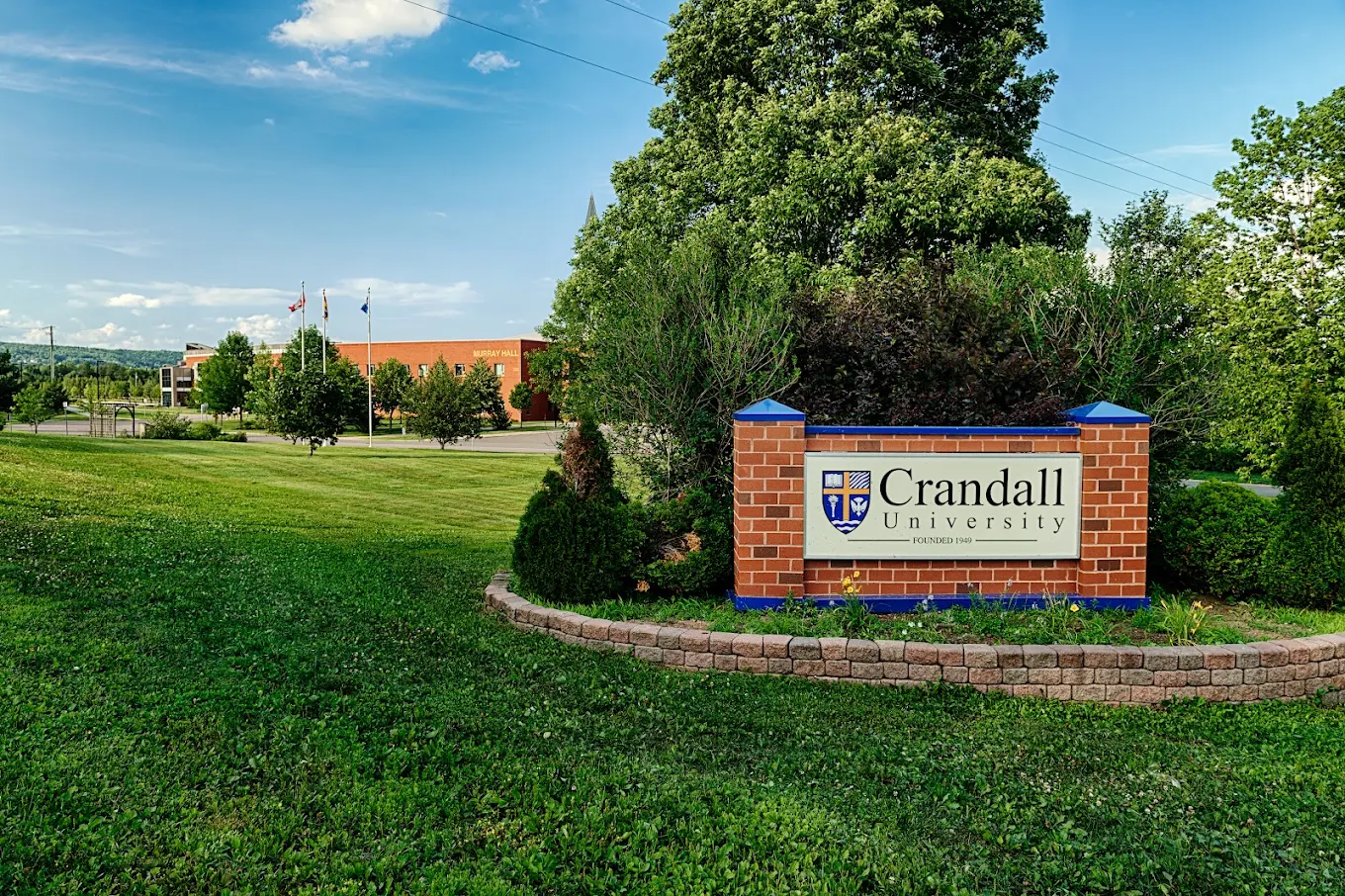
Crandall opened in 1949 as the United Baptist Bible Training School. It became Atlantic Baptist College in 1970, Atlantic Baptist University in 1996, and took its present name in 2009 in honour of Joseph Crandall, a pioneering Baptist minister in the Maritimes. That history explains both the size of the place and its character.
It is a private non profit Christian liberal arts university operated by the Canadian Baptists of Atlantic Canada and recognised by the New Brunswick Department of Post-Secondary Education, Training and Labour. Programs are open to students of all faiths, and the degrees are academic rather than devotional in structure.
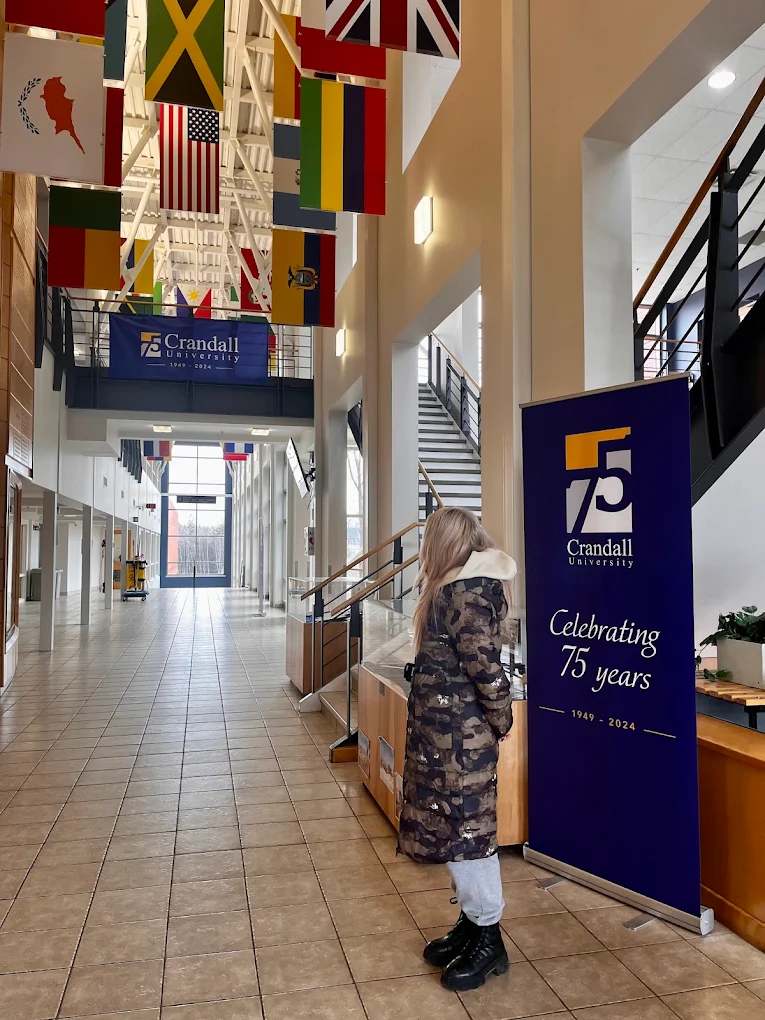
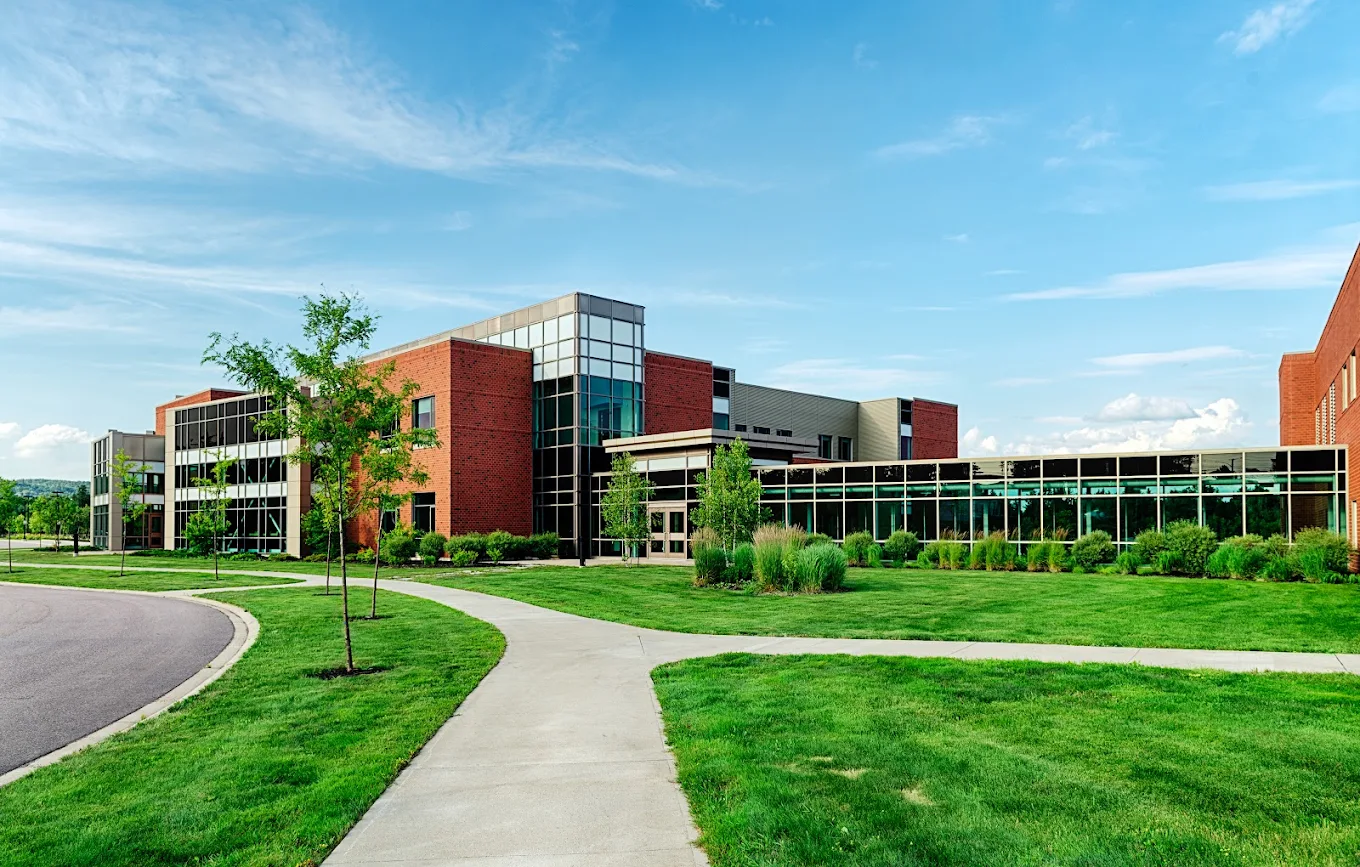
Total enrolment sits at roughly a thousand students. That is genuinely small by Canadian standards, and it is the defining feature of studying here. Class sizes are small enough that professors know students by name, which suits some students perfectly and frustrates others who want the scale and anonymity of a large campus.
Moncton itself is a practical choice. It is the commercial hub of Atlantic Canada, officially bilingual in English and French, and one of the more affordable cities in the country. Transport, logistics, financial services and customer operations all have a real presence, which matters for part time work and for graduate employment.
| Institution | Crandall University |
|---|---|
| Type | Private non profit Christian liberal arts university |
| Founded | 1949 |
| Location | 333 Gorge Road, Moncton, New Brunswick |
| Enrolment | Around 1,000 students |
| Programs for international students | 14, all degrees |
| Undergraduate tuition | CAD 17,900 per year |
| Postgraduate tuition | CAD 18,075 or CAD 26,880 per year |
| Application fee | CAD 100, non refundable |
| English | IELTS 6.5 with no band below 6.0 |
| DLI number | O19391275763 |
All 14 programs and fees
Twelve bachelor degrees and two master degrees. Note the flat undergraduate pricing, which is unusual in Canada and genuinely useful.
| Program | Length | Annual tuition (CAD) |
|---|---|---|
| Bachelor of Arts in Biblical Studies | 4 years | 17,900 |
| Bachelor of Arts in Communication Arts, Theatre | 4 years plus optional 3 month internship | 17,900 |
| Bachelor of Arts in English | 4 years | 17,900 |
| Bachelor of Arts in History | 4 years plus optional internship | 17,900 |
| Bachelor of Arts in Interdisciplinary Studies | 4 years plus optional internship | 17,900 |
| Bachelor of Arts in Psychology | 4 years plus optional practicum | 17,900 |
| Bachelor of Arts in Religious Studies | 4 years | 17,900 |
| Bachelor of Arts in Sociology | 4 years plus optional internship | 17,900 |
| Bachelor of Arts in Kinesiology | 4 years | 17,900 |
| Bachelor of Arts and Science | 4 years | 17,900 |
| Bachelor of Business Administration with optional co-op | 4 years | 17,900 |
| Bachelor of Science in Biology | 4 years | 17,900 |
| Master of Management | 2 years plus optional 12 week internship | 18,075 |
| Master of Organizational Management | 12 months | 26,880 |
Every undergraduate degree costs the same. Business, science, arts, kinesiology, all CAD 17,900. At most Canadian universities business and science carry a premium that pushes students toward programs on price rather than fit. Here that pressure does not exist, so choose the subject you will actually finish.
Note also how many arts degrees carry an optional internship or practicum. History, Sociology, Interdisciplinary Studies, Psychology and Communication Arts all include one, and the Bachelor of Business Administration offers co-op. For a humanities graduate, documented work experience is the difference between explaining what your degree taught you and pointing at what you delivered.
The two master degrees, and why the cheaper one wins
If you are looking at postgraduate study here, this is the most important comparison on the page, and the answer is counterintuitive.
| Feature | Master of Management | Master of Organizational Management |
|---|---|---|
| Length | 2 years | 12 months |
| Annual tuition | CAD 18,075 | CAD 26,880 |
| Internship | Optional 12 week internship | None recorded |
| Entry requirement | 3 year bachelor degree at 70 per cent | 3 year bachelor degree at 60 per cent |
| Spouse open work permit | Qualifies | Does not qualify |
The two year program is cheaper per year, adds an internship, and qualifies for the spousal work permit. The twelve month program costs nearly nine thousand dollars more each year, has no internship recorded, and does not qualify. Its only advantage is speed and a lower entry average.
For a married applicant the gap is not close. A spouse legally working in Canada for two years changes the household finances far more than saving a year of study time. For a single applicant who genuinely needs the qualification fast and cannot meet 70 per cent, the shorter route has a case, but it should be a deliberate choice rather than an accident.
Admission requirements
- Undergraduate: completion of a preparatory program leading to university entrance in your own country, with a 70 per cent average across your best five academic subjects in your final year of school. Generally an academic language arts course plus at least four further university preparatory courses.
- Transfer applicants: an overall GPA of 2.0 on a 4.3 scale from your previous institution.
- Master of Management: a three year bachelor degree at 70 per cent.
- Master of Organizational Management: a three year bachelor degree at 60 per cent, the most accessible entry point here.
- Credential evaluation: transcripts must be in English, and a course by course evaluation may be required at your own cost.
- Application fee: CAD 100, non refundable, and a tuition deposit is required after acceptance to reserve your seat.
- No essay or interview is part of the process. Decisions rest on academic record and documentation.
Be careful with the entry average. Some listing sites publish 60 per cent for undergraduate entry at this university. The requirement stated for international applicants is 70 per cent across the best five academic subjects, which is a meaningfully higher bar and calculated in a specific way. Apply Study Visa recalculates your average on that basis before submitting, because an application built on the wrong figure wastes the CAD 100 fee.
The subject prerequisites nobody mentions
This section exists because we have never seen it covered on another page about this university, and it disqualifies applicants who otherwise look eligible.
- Bachelor of Business Administration: a university preparatory mathematics course is required.
- Bachelor of Science in Biology: a university preparatory mathematics course is required, and preparatory courses in biology and chemistry.
If you studied a commerce or humanities stream in Class 12 without mathematics, the business degree is closed to you regardless of your average. If you took biology without chemistry, or chemistry without biology, the science degree is closed. Neither of these appears in the headline entry requirement, and both are checked at assessment.
The practical consequence: check your Class 12 subject combination before you choose a program, not after. The arts degrees, kinesiology and the Bachelor of Arts and Science carry no such subject gate, which is why they remain open to a wider range of applicants.
English requirements
| Test | Requirement |
|---|---|
| IELTS Academic | 6.5 overall, no band below 6.0 |
| PTE Academic | 65 overall |
| TOEFL iBT | 100 total, no section below 24 |
| Duolingo English Test | 115 |
| Waiver | None recorded |
One standard covers every program, undergraduate and postgraduate alike, which makes planning simple. One test result covers your whole shortlist.
Two points worth flagging. The TOEFL requirement of 100 is high, noticeably tougher than the IELTS 6.5 equivalent most institutions set, so IELTS is usually the easier route here. And no waiver is recorded, so a medium of instruction letter will not substitute for a test score even if you studied entirely in English.
Cost of living in Moncton
| Expense | Monthly (approx. CAD) |
|---|---|
| Shared accommodation | 550 to 900 |
| Groceries | 300 to 400 |
| Transport | 70 to 120 |
| Utilities, phone, personal | 200 to 300 |
| Realistic total | 1,120 to 1,720 |
An annual living budget of roughly CAD 14,000 to 20,000 is realistic. Moncton is consistently among the more affordable Canadian cities, and combined with flat tuition of CAD 17,900 the total annual cost sits well below what the same degree would cost in Toronto or Vancouver.
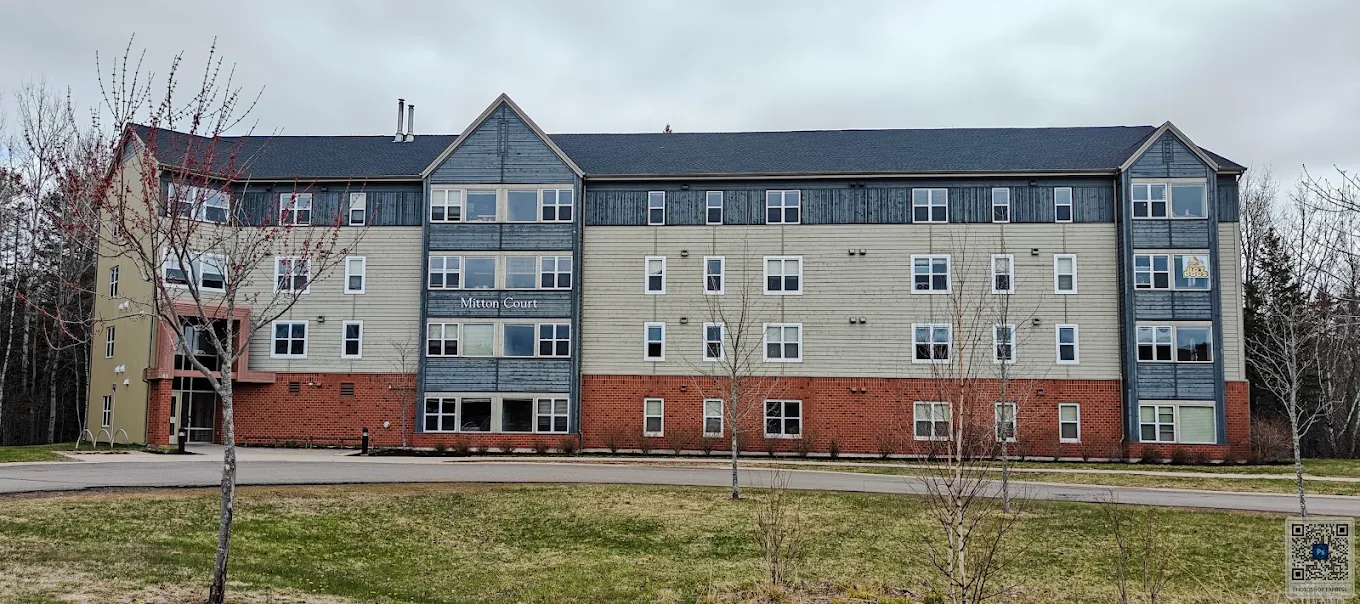
The university offers on campus residence through Colburne House and Mitton Court Apartments, which is worth applying for immediately after you accept an offer. Being officially bilingual, Moncton also rewards students with any French at all when it comes to part time work.
Scholarships
Crandall operates an unusually straightforward entrance award system. Applicants with strong secondary school results are considered automatically for entrance scholarships rather than having to submit a separate application, and awards are generally renewable across the years of the degree provided academic standing is maintained.
Program specific awards also exist, including entrance scholarships attached to the organizational management route. Amounts vary by year and by academic profile, so treat any figure you see quoted elsewhere with caution.
The sensible approach is to budget on the assumption that you receive nothing, and treat any award as a reduction in cost rather than a plank of your funding plan. Apply Study Visa will tell you what you are realistically likely to be considered for based on your actual transcript.
Intakes and deadlines
Intake availability splits cleanly by level, and this catches applicants out:
- All twelve bachelor degrees: September entry only. There is no January or May start for undergraduate study. Miss the September window and you wait a full year.
- Both master degrees: September, January and May. Three entry points a year, which is genuinely flexible and useful when a visa timeline slips.
Undergraduate application deadlines for the September cycle generally fall in the spring, with rolling assessment afterwards where seats remain. Apply six to nine months ahead. The chain of application, offer, tuition deposit, provincial attestation letter and study permit needs runway, and the September only undergraduate pattern makes a missed deadline expensive.
Work permit: why every program qualifies
This is where Crandall’s catalogue does something most institutions cannot.
Since November 2024, graduates of non degree programs can only obtain a post graduation work permit if their program CIP code appears on the eligible field of study list. That list is reviewed periodically, and college diploma students have watched programs move on and off it.
Degree level programs are exempt from that requirement entirely. And every one of Crandall’s fourteen programs is a bachelor or master degree. There is no CIP code to check, no eligible field of study list to monitor, and no risk of your program losing eligibility mid course. For a four year commitment, that stability has real value.
The caveat, and it matters. Crandall is a private institution. Program level is only half the test; the school itself must appear on the designated learning institution list as offering programs that make graduates eligible. Most public institutions do. Private ones require checking, and choosing a private institution without verifying this is one of the more expensive mistakes an international student can make.
Crandall holds a DLI number and its degree programs are widely reported as qualifying, but Apply Study Visa verifies the current position in writing for your specific program before any deposit is paid. Every work permit decision rests with Canadian immigration authorities, and no institution or consultancy can guarantee an outcome.
The spouse permit trap
If you are married, read this before choosing between the two master degrees. It is worth more than the tuition difference.
Spousal open work permits for partners of international students are restricted to students enrolled in a master program of at least sixteen months, a doctoral program, or a listed professional degree. Undergraduate degrees and college credentials do not qualify at all.
| Program | Length | Spouse eligible |
|---|---|---|
| Master of Management | 2 years | Yes |
| Master of Organizational Management | 12 months | No, four months short of the threshold |
| All twelve bachelor degrees | 4 years | No, undergraduate study does not qualify |
One of the fourteen programs qualifies. A twelve month master degree is four months short, and length is the only thing that decides it. The subject, the level and the institution are all irrelevant to this test.
Two further conditions to plan around. Where a letter of acceptance states a range of program lengths, the lower end of that range must reach sixteen months, so a letter reading twelve to eighteen months is not sufficient. And a spousal application can be refused if the student is in their final academic term when it is received, which on a short program arrives very quickly. Apply early in the program, not late.
The honest view
It is small. Around a thousand students. That means personal attention and it also means limited program choice, fewer clubs, fewer research opportunities and a quieter campus than a large university.
It is a Christian institution. Operated by a Baptist body, with biblical and religious studies among its founding disciplines. Programs are open to all faiths and the teaching is academic, but the institutional character is real and applicants should want it or at least be comfortable with it.
The program list is narrow. No engineering, no computing, no nursing, no health sciences beyond kinesiology. If your field is not among the fourteen, this is simply not your university.
Moncton is a mid sized city. Affordable and welcoming, with a smaller South Asian community than the big centres, and Atlantic winters that need proper clothing budgeted before arrival.
It is private. That is not a problem in itself, but it puts the burden on you to verify work permit standing rather than assuming it, in a way that a public university would not.
Against all that: every program is a degree, the fee is low and flat, classes are small, internships are built in, and the cost of living is among the lowest in Canada.
How to apply
- Check your Class 12 subject combination first, especially mathematics for business and mathematics with biology and chemistry for science.
- Recalculate your average across your best five academic subjects, which is how the 70 per cent bar is measured.
- If you are married and considering postgraduate study, choose the Master of Management, unless you have a specific reason not to.
- Book IELTS. You need 6.5 overall with 6.0 in every band, and there is no waiver.
- Prepare transcripts in English and be ready for a course by course evaluation at your own cost.
- Apply and pay the CAD 100 fee, remembering that undergraduate entry is September only.
- Pay the tuition deposit after acceptance to reserve your seat and trigger your provincial attestation letter.
- Apply for your study permit, and apply for campus residence at the same time.
Verdict
Crandall is a narrow option that fits a specific student very well.
It works if your subject is on the list, you want a Canadian degree at a predictable CAD 17,900 a year, you value small classes and direct access to professors, and you want the work permit certainty that comes from every program being a degree. The optional internships across the arts degrees are a genuine differentiator for humanities students who would otherwise graduate with no work record.
For postgraduate applicants, the Master of Management is the standout: cheaper per year than its twelve month sibling, longer, with an internship, and the only program here that opens a spousal work permit.
It does not work if your field is not among the fourteen, if you need a large campus, if you lack the Class 12 subject prerequisites for business or science, or if you are married and about to choose the twelve month master degree without understanding what that does to your partner’s right to work.
The mistake we see most often with small private universities is applicants assuming that a low profile means low standards and easy entry. A 70 per cent average across five academic subjects, IELTS 6.5 with no band below 6.0, and hard subject prerequisites say otherwise.
Frequently asked questions
Where is Crandall University located?
At 333 Gorge Road in Moncton, New Brunswick, on Canada’s Atlantic coast. Several listing sites incorrectly place it in Montreal, Quebec, which is a different city in a different province.
How much are Crandall University fees for international students?
Every undergraduate degree is CAD 17,900 per year. The Master of Management is CAD 18,075 and the Master of Organizational Management is CAD 26,880. The application fee is CAD 100 and is non refundable.
What is the Crandall University acceptance rate?
The university does not publish one, and third party figures range from 30 to 89 per cent, which tells you they are estimates. Meeting the stated average, the English requirement and the subject prerequisites is what actually decides your outcome.
What are the admission requirements for international students?
Undergraduate entry is a 70 per cent average across your best five academic subjects in your final school year. Postgraduate entry is a three year bachelor degree at 70 per cent for the Master of Management or 60 per cent for the Master of Organizational Management. Transfer applicants need a 2.0 GPA on a 4.3 scale.
Does the Bachelor of Business Administration need mathematics?
Yes. A university preparatory mathematics course is required for the Bachelor of Business Administration and for the Bachelor of Science. The Bachelor of Science additionally requires preparatory biology and chemistry.
What IELTS score does Crandall University require?
IELTS Academic 6.5 overall with no band below 6.0, applied identically to all fourteen programs. PTE 65, TOEFL iBT 100 with no section below 24, and Duolingo 115 are also accepted, and no waiver is recorded.
Is Crandall University PGWP eligible?
All fourteen programs are degrees, and degree level programs are exempt from the field of study requirement, so no CIP code check applies. Crandall is private, so confirm the school on the designated learning institution list before relying on it.
Can my spouse work while I study at Crandall University?
Only on the Master of Management, which runs two years. Spousal open work permits require a master program of at least sixteen months, so the twelve month Master of Organizational Management does not qualify, and no undergraduate degree qualifies.
Is Crandall University private or public?
Private and non profit, a Christian liberal arts university operated by the Canadian Baptists of Atlantic Canada and recognised by the New Brunswick Department of Post-Secondary Education, Training and Labour. Programs are open to students of all faiths.
What intakes does Crandall University offer?
All twelve bachelor degrees are September entry only. Both master degrees offer September, January and May.
Do I have to be Christian to study at Crandall University?
No. The university is Christian in foundation and character, and its programs are open to students of all faiths and backgrounds.
How do I apply to Crandall University?
The simplest route is through the Apply Study Visa portal. We check your Class 12 subject combination against the program prerequisites, recalculate your average on the best five academic subjects, assess your spousal work permit position if you are married, and our certified counsellors review and submit your file for free before guiding you through the deposit, the attestation letter, your GIC and your study permit.
Does Apply Study Visa charge for Crandall University applications?
No. Application review and submission through Apply Study Visa is free, including the prerequisite and work permit checks that decide whether your chosen program is actually open to you, with the same team supporting your visa, GIC and travel afterwards.
Quick facts
| Type | Private Non Profit University |
|---|---|
| Location | Moncton, New Brunswick, Canada |
| Established | 1949 |
| Rating | 4.2 out of 5 |
| DLI number | O19391275763 |
| Application fee | C$100 |
| Undergraduate tuition | C$17,900 per year |
| Postgraduate tuition | C$18,075 to C$26,880 per year |
| Cost of living per year | Around C$14,000 to C$20,000 |
| Programs | 14, all degrees |