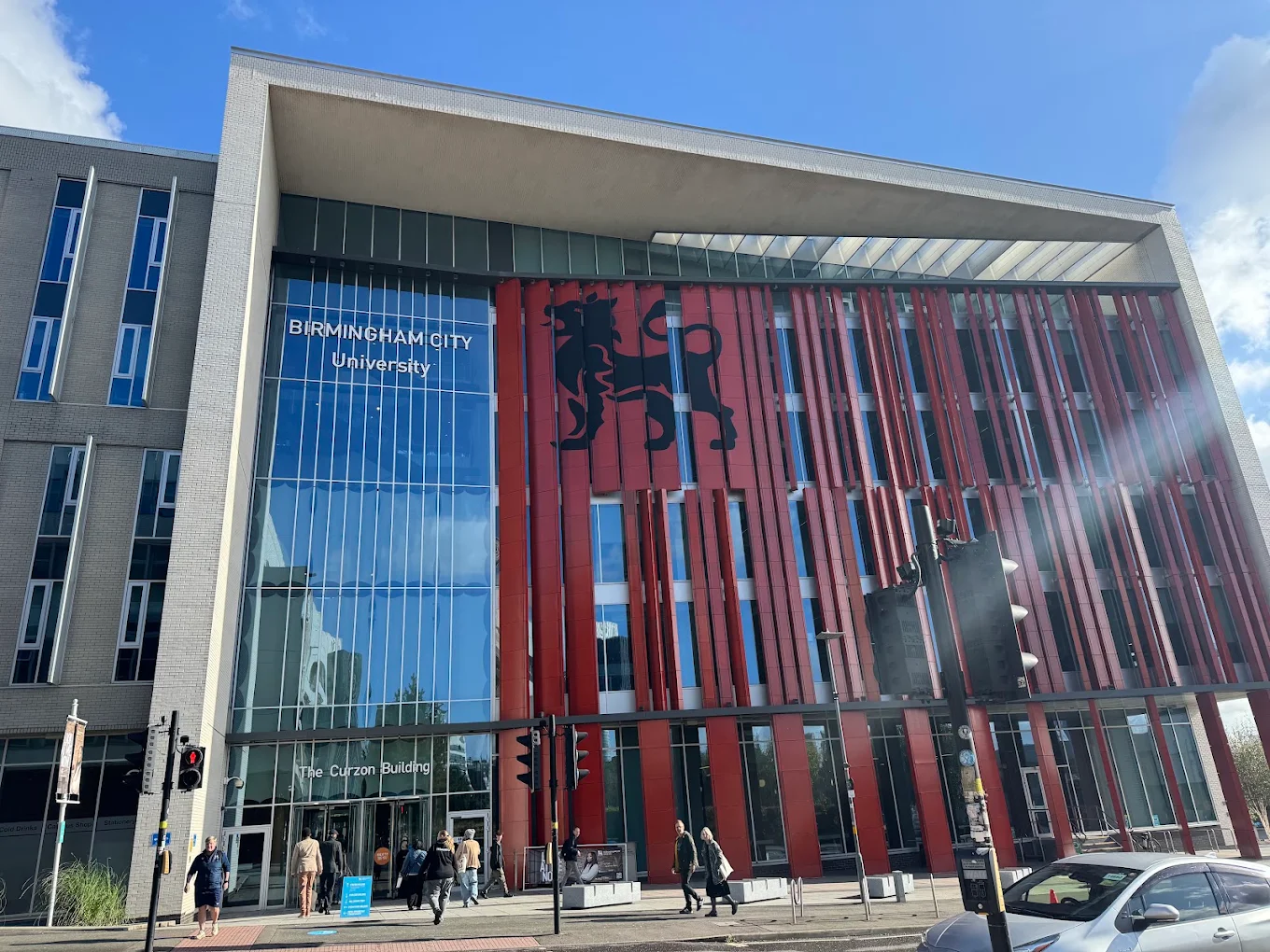
Birmingham City University charges no application fee on any of its 250 courses and asks for no GMAT or GRE anywhere, including on its MBA. It also refuses the Duolingo English Test on every single course, which is the one thing that will stop an application dead if nobody tells you first.
Those three facts matter more to an Indian applicant than any ranking, and none of them appear prominently on the pages currently competing for this search.
What follows is built from all 250 programmes open to international students, checked one by one. Where the widely circulated figures disagree with each other, Section 5 says so plainly.
🎓 Quick Fact: One widely read site says BCU was founded in 1843. Another says 1971. That is a gap of 128 years on the single most basic fact about the institution, and both pages are aimed at Indian students. Section 16 lists what else those pages get wrong.
What this guide covers
- About Birmingham City University
- Rankings and what they actually say
- What BCU is known for
- Courses for international students
- The acceptance rate question
- Admission requirements
- English requirements, and the Duolingo problem
- Fees
- Cost of living in Birmingham
- Scholarships
- Intakes and deadlines
- The professional placement year
- Foundation and top-up routes
- The UK Graduate Route
- Protected titles: read this before applying
- What other BCU pages get wrong
- How to apply
- Is BCU good for Indian students?
- FAQs
1. About Birmingham City University
BCU traces its origins to 1843 and the Birmingham College of Art, gaining full university status in 1992. It is a public university with degree awarding powers, teaching from campuses across Birmingham including the City Centre campus and the Royal Birmingham Conservatoire.
It is a modern, career-focused university rather than a research-intensive one, and it competes on applied teaching, industry links and employability rather than on academic prestige.
| Detail | Information |
|---|---|
| Institution | Birmingham City University (BCU) |
| Type | Public university with degree awarding powers |
| Origins | 1843 as the Birmingham College of Art. University status 1992 |
| Location | Birmingham, West Midlands |
| Courses open to international students | 250: 126 bachelors, 114 masters, 8 top-ups, 1 four-year, 1 HND |
| Application fee | GBP 0 on all 250 courses |
| GMAT or GRE | Not required on any course, including the MBA |
| Duolingo English Test | NOT accepted on any of the 250 courses |
| Tuition | GBP 18,570 to 28,460. GBP 18,570 on 126 courses |
| Entry bar | Masters 70 percent. Bachelors 60. Foundation and top-up 50 |
| Official website | www.bcu.ac.uk |
2. BCU Rankings 2026
BCU sits in the middle band of British universities globally, and the published figures are consistent across sources, which is unusual on this page.
| Ranking | Position |
|---|---|
| Times Higher Education World Rankings 2026 | 801 to 1000 globally |
| QS World University Rankings 2026 | 1001 to 1200 globally |
| Sustainability, People and Planet League 2025 to 2026 | Number one in Birmingham, top 10 percent in the UK |
| Graduate outcomes | Reported at 97.4 percent in work or further study within six months |
3. What Is BCU Known For?
- The Jewellery Quarter. BCU teaches gemmology, jewellery and silversmithing, and horology inside Birmingham’s historic Jewellery Quarter, a working trade district. Horology is among the rarest degrees in Britain. No other UK university offers this cluster.
- The Royal Birmingham Conservatoire. Music performance, acting, stage management and musical theatre, taught in a purpose built conservatoire.
- Games. Four separate game disciplines, each with a foundation route: art, design, programming and technology.
- Automotive and engineering. The West Midlands is Britain’s vehicle manufacturing heartland, and BCU runs automotive engineering with a placement route into it.
- Construction and surveying. Quantity surveying, building surveying, construction management and real estate, several with routes toward RICS chartership.
- The placement year. 137 of the 250 courses include or offer a professional placement, which is the highest proportion in our UK catalogue.
4. BCU Courses for International Students
| Level | Count | Entry from | Typical fee |
|---|---|---|---|
| Bachelor degrees | 126 | Class 12 at 60 percent | GBP 18,570 |
| Master degrees | 114 | A bachelor degree at 70 percent | GBP 18,970 |
| Top-up degrees | 8 | A recognised diploma at 50 percent | GBP 18,570 for one year |
| Four-year bachelor | 1 | Class 12 | GBP 28,460, Music Technology |
| Higher National Diploma | 1 | Class 12 at 50 percent | GBP 18,970, Jewellery and Silversmithing |
Within that, 44 courses include an integrated foundation year, and 137 include or offer a professional placement. Browse every course with its exact fee and entry requirement on our BCU courses and fees page.
5. What Is the BCU Acceptance Rate?
BCU does not publish one. Three different figures circulate on pages aimed at Indian students:
| Claimed rate | How it is described |
|---|---|
| 52 percent | Described as competitive, attributed to third party sources |
| 50 to 53 percent | Described as moderately selective |
| 75 percent | Attributed to an unofficial source |
6. BCU Admission Requirements for Indian Students
| You need | Courses | Which |
|---|---|---|
| 70 percent | 114 | Every master degree, taught and research |
| 60 percent | 83 | Direct entry bachelor degrees |
| 50 percent | 53 | All 44 foundation routes, all 8 top-ups, and the HND |
There is no GMAT or GRE requirement on any of the 250 courses, including the MBA. That removes a barrier many applicants assume exists.
7. BCU English Language Requirements
| Band | Courses | IELTS | TOEFL | PTE |
|---|---|---|---|---|
| Standard | 216 | 6.0, no band below 5.5 | 72 | 59 |
| Higher | 19 | 6.5, no band below 6.0 | 86 | 59 |
| Writing focused | 7 | 6.0 with writing at 6.0 | 72 | 59 |
| High | 7 | 7.0, no band below 6.5 | 95 | 76 |
| Speaking focused | 1 | 7.0 with speaking at 7.0 | 95 with speaking 25 | 76 |
The seven writing focused courses are English, journalism, creative writing and sports journalism. A student with 6.0 overall but 5.5 in writing meets the standard band and fails these seven. Nothing in the course name signals it.
The seven high band courses include Biomedical Sciences, Human Biosciences, Creative Writing, Sport and Exercise Nutrition and Strength and Conditioning. The single speaking focused course is the Master of Fine Arts in Acting, unique in the catalogue.
8. BCU Fees for International Students 2026
| Course group | Annual fee (GBP) | Courses |
|---|---|---|
| Bachelor degrees, foundation and top-up routes | 18,570 | 126 |
| Taught masters and some specialist courses | 18,970 | 71 |
| Masters with professional placement | 20,865 | 41 |
| Performance courses and specialist law | 20,370 to 20,960 | 8 |
| MBA and international business law with placement | 22,405 | 3 |
| Music Technology, four years | 28,460 | 1 |
9. Cost of Living in Birmingham
Birmingham is substantially cheaper than London, which is the main financial argument for choosing it. It is Britain’s second largest city with a large student population and good transport.
| Item | Approximate monthly cost (GBP) |
|---|---|
| Room in a shared house | 450 to 650 |
| Student accommodation | 600 to 900 |
| Food and groceries | 180 to 280 |
| Travel, phone and miscellaneous | 120 to 220 |
| Realistic annual total | 9,500 to 14,000 |
That is roughly GBP 4,000 to 5,000 a year less than London, which over a three year degree is a saving comparable to a full year of tuition. For a self-funding family in Punjab, that difference is often the deciding factor.
Budget separately for the Immigration Health Surcharge, paid upfront for the full length of your visa, and the visa fee itself. Both are separate from tuition and living costs.
10. BCU Scholarships for International Students
BCU offers scholarships and bursaries to international students, and one widely reported arrangement is a GBP 300 discount for paying tuition in full before travelling or at enrolment.
11. BCU Intakes and Deadlines
| Intake | Courses offering it |
|---|---|
| September | 249 of 250 |
| January | 44 |
| June | 2 |
12. The Professional Placement Year
This is BCU’s strongest structural feature and the one worth planning around. One hundred and thirty seven of the 250 courses include or offer a professional placement.
On the masters, the arithmetic is unusually clear. A taught master costs GBP 18,970 over twelve months. The same subject with a placement costs GBP 20,865 over eighteen months.
13. Foundation Years and Top-Up Degrees
Forty four courses include an integrated foundation year, accepting 50 percent where direct entry asks 60. The foundation year is genuinely useful in some subjects and expensive padding in others.
| Where it earns its place | Why |
|---|---|
| Engineering, computing, game programming | These degrees assume calculus, mechanics or programming from the first term. The extra year closes a real gap |
| Art, design, architecture, game art | These normally expect a portfolio at application. The foundation year is where someone without one builds it |
| General business and broad media degrees | Harder to justify. Four years and roughly GBP 74,000 in tuition for the most crowded graduate market in Britain |
The eight top-up degrees are the best value in this catalogue. A recognised diploma plus one year at GBP 18,570 produces a full British honours degree and Graduate Route access. Available in international business, marketing, finance, business administration, computing, building surveying and jewellery design.
14. The UK Graduate Route at BCU
All 250 courses are degrees or degree-level qualifications, so they support a Graduate Route application. The Graduate Route gives two years of unsponsored work in Britain after you finish, or three years after a doctorate. No job offer or sponsor is needed, but you must be inside the UK on a valid student visa when you apply.
Foundation routes and top-ups qualify, because both finish with a full honours degree.
15. Protected Titles: Read This Before You Apply
| Course | What it does not do |
|---|---|
| Architectural Technology and Interior Architecture and Design | Do not lead to registration as an architect. Architect is a protected title requiring a separate accredited route through the Architects Registration Board |
| BA Architecture and Master of Architecture | These are the first two of three academic stages. Full registration takes around seven years including recorded practical experience |
| Professional Policing and Criminology, Policing and Investigation | Do not confer eligibility to serve. UK forces require nationality, settled status and multi year residency. Target corporate security and fraud investigation instead |
| Nursing, Adult and Mental Health | Require Nursing and Midwifery Council registration, assessed separately. Clinical placement capacity for international students should be confirmed in writing first |
| Psychology courses | Need British Psychological Society accreditation to open professional routes. Verify this for combined degrees specifically, such as psychology with criminology or with counselling |
| Biomedical Sciences | Needs HCPC registration, requiring an accredited degree plus a completed laboratory training portfolio. Note that Human Biosciences does not carry this route despite asking the same IELTS 7.0 |
| LLB Law and the LLM conversion | Do not confer the right to practise. Solicitors need the SQE plus two years of qualifying work experience |
| Education Studies and Arts and Education Practices | Are not teacher training. Teaching in UK state schools needs qualified teacher status through a separate route |
16. What Other BCU Pages Get Wrong
| Claim you will see | The actual position |
|---|---|
| “Founded in 1971” | Other pages say 1843, and BCU traces its origins to the Birmingham College of Art of that year. A 128 year discrepancy on the most basic fact tells you how carefully the rest of that page was checked |
| “An application fee of GBP 20 to 27 may apply” | Our data shows zero application fee on all 250 courses. Quoting a fee that does not exist may deter applicants unnecessarily |
| “Total cost of a degree is GBP 7,725 to 20,645 for the first year” | The lowest fee on any of the 250 courses is GBP 18,570. A figure of GBP 7,725 does not correspond to any international course at BCU |
| A guaranteed GBP 3,000 scholarship at the University of Birmingham, on a BCU page | That is a different institution. Birmingham has two large universities with similar names, and nothing transfers between them |
| Acceptance rate of 52 percent, or 50 to 53, or 75 percent | BCU publishes none of these. What decides your application is the 70 percent master requirement or the 60 percent bachelor one |
| “368 undergraduate courses and 312 graduate”, or “over 100 postgraduate and 159 undergraduate” | Both appear on pages aimed at the same students, and the same page also claims “more than 1000 courses”. 250 are open to international students |
| Nothing at all about Duolingo | None of the pages we reviewed mentions that BCU refuses Duolingo entirely. It is the single most actionable fact for an applicant choosing which English test to book |
17. How to Apply to BCU
You can apply directly to BCU. The better route is through the Apply Study Visa portal, where our counsellors review and submit your file free of charge. Since BCU charges no application fee, the entire application costs you nothing.
- Check your English test first. This is step one at BCU specifically. If you hold only a Duolingo score, you cannot apply and will need to book IELTS, TOEFL or PTE before anything else.
- Choose your course on our portal. We confirm the exact entry percentage and English band, since BCU varies both between courses that sound similar.
- Upload your documents online. We check your band scores, not just your overall, because seven courses need 6.0 in writing specifically and one needs 7.0 in speaking.
- We map your route. If your degree is below 70 percent, we compare the foundation and top-up options that accept 50 percent and lead to the same award.
- We submit at no cost, then guide you through the deposit, CAS, financial evidence and UK student visa as one process.
The three costly mistakes at BCU are booking a Duolingo test that BCU will not accept, missing the September intake when only 44 courses offer January, and choosing a course whose name does not match the profession you want. Each is avoidable with one conversation. Check your eligibility for BCU free, or read our UK student visa guide if funds are your next step.
🛂 Planning a UK student visa? The team at ApplyStudyVisa.com handles the full sequence from transcript assessment and offer through the CAS, financial evidence, biometrics and visa decision. Contact our Ludhiana office for a free assessment.
18. Is BCU Good for Indian Students?
BCU suits a specific profile well. If you want British study outside London at a materially lower cost, if you value a placement year over academic prestige, and if your marks are solid rather than exceptional, it lines up sensibly.
The placement provision is the strongest argument: 137 of 250 courses, with a premium of GBP 1,895 for six months of British work experience that on several courses counts toward professional chartership.
The honest counterweights are that the 70 percent master requirement is higher than many British universities, that only 44 courses offer a January start, and that Duolingo is refused entirely.
It suits you if
- Your degree is 70 percent or above, or you are open to a foundation or top-up route at 50.
- You want Birmingham costs rather than London ones, saving roughly GBP 4,000 to 5,000 a year.
- You want a placement year and British work experience on your record.
- You hold IELTS, TOEFL or PTE rather than only Duolingo.
- You want jewellery, gemmology, horology, music, games, automotive or surveying, where BCU is genuinely distinctive.
- You hold a diploma and want a one year top-up to a full honours degree.
- Your timeline fits a September start.
It does not suit you if
- Your only English test is Duolingo. You cannot apply at all.
- You need a January start and your course is not among the 44 that offer one.
- Your degree is below 70 percent and you will not consider a foundation or top-up route.
- You need to bring a spouse or children. No course here allows it.
- You are targeting research intensive doctoral study or prestige driven employers.
- You want a protected profession such as architecture or UK policing without checking the route first.
19. Frequently Asked Questions (FAQs)
Q: Does BCU accept the Duolingo English Test?
No. Not on any of the 250 courses. If Duolingo is your only English test you cannot apply to BCU and will need to book IELTS, TOEFL or PTE. Confirm this before paying for any test.
Q: What is the BCU acceptance rate?
BCU does not publish one. Pages aimed at Indian students quote 52 percent, 50 to 53 percent and 75 percent. What actually decides your application is the requirement on your course: 70 percent for masters, 60 for bachelors, 50 for foundation and top-up routes.
Q: What are BCU fees for international students?
Tuition runs from GBP 18,570 to GBP 28,460. Most bachelors are GBP 18,570, taught masters GBP 18,970, and masters with a placement GBP 20,865. The outlier is BSc Music Technology at GBP 28,460 over four years.
Q: Does BCU charge an application fee?
No. All 250 courses have a zero application fee, despite one widely read page claiming a fee of GBP 20 to 27. Applying through Apply Study Visa is also free.
Q: Does BCU require GMAT or GRE?
No. Not on any of the 250 courses, including the MBA. That removes a barrier many MBA applicants expect to face.
Q: What IELTS score does BCU require?
6.0 with no band below 5.5 on 216 courses. Nineteen ask 6.5, seven ask 7.0, seven ask 6.0 with writing at 6.0, and one asks 7.0 with speaking at 7.0. Check band scores, not just the overall.
Q: Does BCU have a January intake?
Only on 44 of the 250 courses. September runs on 249. BCU is a September university, so a missed autumn deadline usually means waiting a full year rather than a term.
Q: What percentage do I need for a BCU master?
Seventy percent on all 114 master degrees, which is higher than many British universities. If your degree falls short, the foundation and top-up routes accept 50 percent and lead to bachelor level awards.
Q: What is the professional placement at BCU?
One hundred and thirty seven of the 250 courses include or offer one. On masters it costs GBP 1,895 extra and adds six months. On construction, surveying, automotive and ACCA accounting routes it also counts toward professional chartership requirements.
Q: Is BCU eligible for the UK Graduate Route?
Yes. All 250 courses are degrees or degree level qualifications, giving two years of unsponsored work after you finish. Confirm the position separately for the Higher National Diploma, which is a shorter credential.
Q: Can I bring my spouse or children to BCU?
No. UK rules from January 2024 bar dependants on taught courses, and every BCU course in this catalogue is taught. If a family move is essential, BCU cannot deliver it at this level.
Q: What is BCU known for?
The Jewellery Quarter cluster of gemmology, jewellery and horology, taught inside a working trade district and unavailable at any other UK university. Also the Royal Birmingham Conservatoire, four separate games disciplines, and automotive engineering in Britain’s vehicle manufacturing heartland.
Q: What is the cost of living in Birmingham?
Plan GBP 9,500 to 14,000 a year, roughly GBP 4,000 to 5,000 less than London. Over a three year degree that saving is comparable to a full year of tuition.
Q: Does Apply Study Visa charge for BCU applications?
No. Counselling, application review and submission are free to the student, including the English test check and the band score review. We are paid by the institutions we work with, which is exactly why we will tell you plainly when a course carries a risk.
✅ Confirm before you pay. Confirm your English test is accepted, since BCU refuses Duolingo on every course. Confirm the exact entry percentage and English band for your specific course in writing. Confirm no course supports dependants. If your course leads toward a regulated profession, confirm the registration route separately. Course details cover all 250 routes open to international applicants and were checked in September 2026. Tuition, visa fees and the Immigration Health Surcharge are revised regularly.