
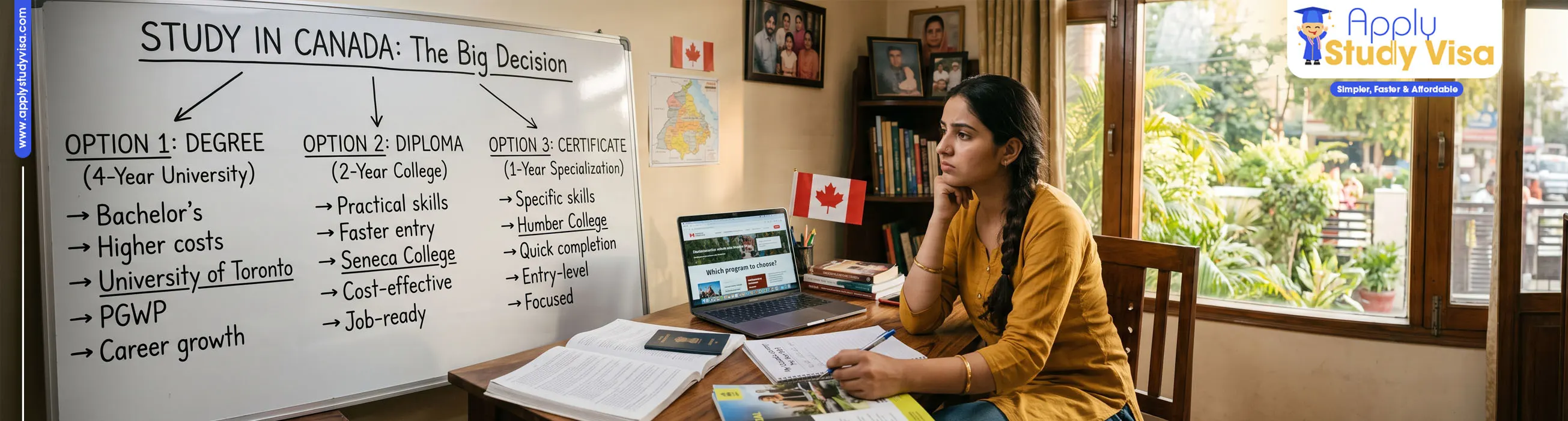

Canada sits among the most popular study abroad destinations on the planet, and the reason is not just its ranked universities or its welcoming, multicultural cities. It is the sheer flexibility of the education system. Depending on where you enrol and what you pick, you can walk away with a degree, a diploma, or a certificate — and each one shapes your timeline, your budget, your career, and, crucially for most international students, your route to a work permit and permanent residency.
Getting this decision right at the start saves you years and lakhs of rupees. Getting it wrong — especially after the 2024–2026 immigration rule changes — can mean graduating with no pathway to stay and work in Canada at all. This guide breaks down every credential clearly, compares them side by side, and shows you exactly how each one affects your Post-Graduation Work Permit (PGWP) and PR chances in 2026.
Quick Comparison: Degree vs Diploma vs Certificate at a Glance
Before we go deep, here is the whole picture in one table.
| Feature | Certificate | Diploma | Degree |
|---|---|---|---|
| Typical length | Under 1 year | 1 to 3 years | 3 to 7 years |
| Study level | Mostly undergraduate | Undergraduate / graduate | Undergraduate & graduate |
| Offered mainly by | Colleges, career schools | Colleges (some universities) | Universities (some colleges) |
| Focus | One specific skill | Job-ready, hands-on | Academic + theoretical depth |
| Indicative fees/yr | CAD 7,000–20,000 total | CAD 14,000–22,000/year | CAD 20,000–45,000+/year |
| PGWP field-of-study rule | Applies (must be eligible field) | Applies (must be eligible field) | Exempt — all fields qualify |
| PGWP language need | CLB 5 (IELTS ~5.0) | CLB 5 (IELTS ~5.0) | CLB 7 (IELTS ~6.0) |
| Best for | Upskilling fast | Practical career + faster PR runway | Long-term career + stable PR path |
Keep this table in mind — the last three rows are where most students go wrong, and we will unpack them fully below.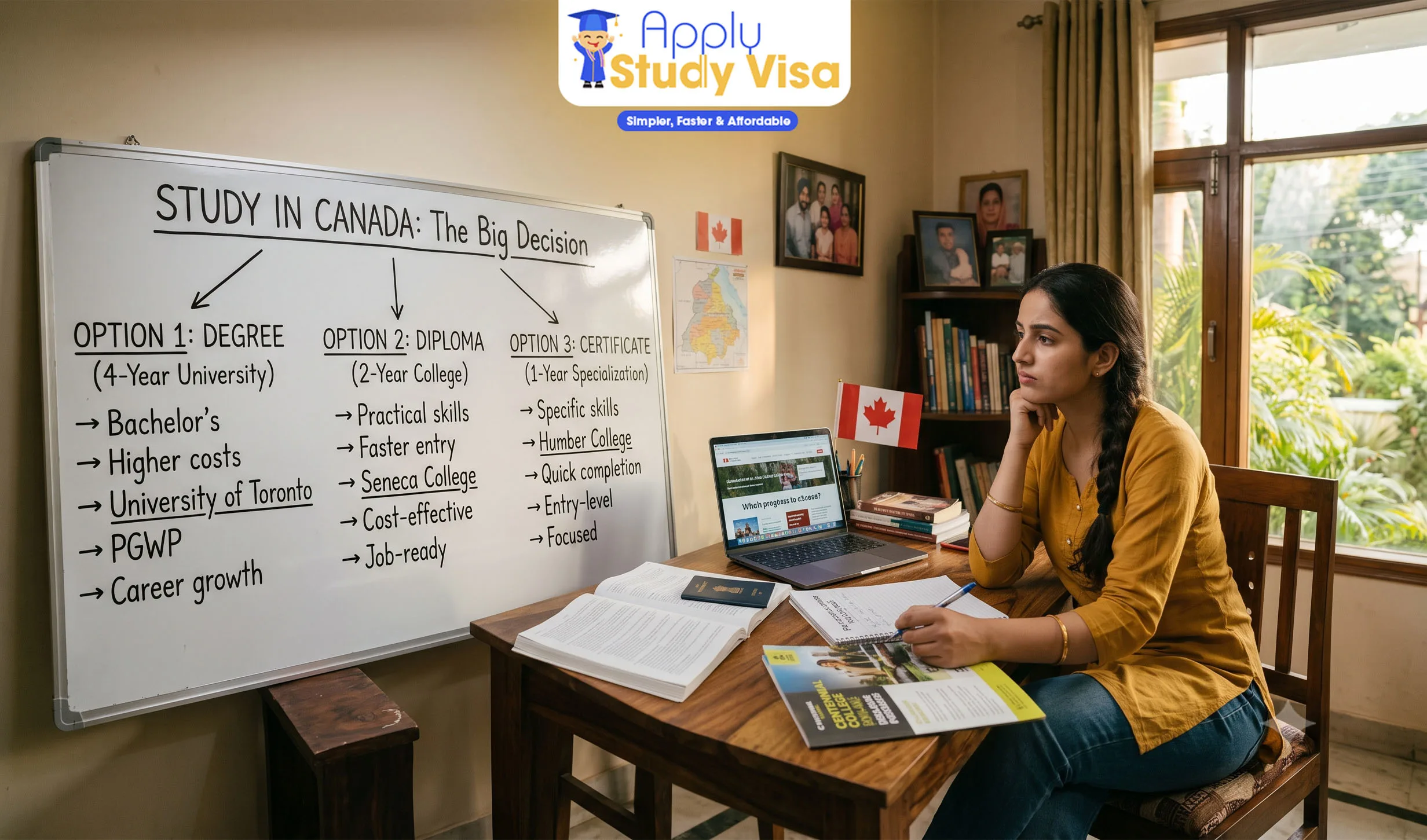
First Decision: What Type of Canadian Institution Should You Attend?
Your credential is tied to the kind of institution you join. Canada has four main types of post-secondary providers, and knowing the difference matters more than ever in 2026 because your school's status directly affects whether you can work after graduation.
Universities award bachelor's, master's and doctoral degrees that carry global recognition. They range from compact liberal-arts campuses to large research powerhouses. If your plan is academic depth and a stable long-term future, this is usually the anchor.
Colleges (also called community colleges or institutes of technology) specialise in applied, career-focused learning with smaller classes and more instructor contact. They award diplomas and certificates, and a growing number now also grant bachelor's degrees.
Polytechnics sit between colleges and universities. They blend hands-on training with higher-level credentials, and are strong in engineering technology, IT, health and applied research.
Career, technical and vocational schools deliver short, occupation-specific training for a particular trade or job. Many are private, and here is the 2026 warning: most private career colleges are not eligible for the PGWP. Always confirm a school's DLI status and PGWP eligibility before you pay a single rupee.
Apply Study Visa tip: A "Designated Learning Institution" (DLI) number is not the same as PGWP eligibility. A school can be a DLI yet still leave you without a work-permit route. We verify both for every student before recommending a program.
Degrees in Canada Explained
A degree is the most academically weighted credential and, in 2026, the most immigration-stable one. There are four levels.
Associate Degree
A shorter undergraduate qualification, common in British Columbia, that covers the first two years of university-level study. It works well as a stepping stone into a full bachelor's program through a transfer arrangement.
- Length: 2 years
- Level: Undergraduate
- Entry requirement: Class 12 / high school completion
- Offered by: Some universities and colleges
Bachelor's Degree
The foundational university qualification and the classic route to a professional career or further study. Most bachelor's programs run four years, though some are three, and many now include a co-op or work placement that gives you paid Canadian experience before you even graduate.
- Length: 3 to 4 years
- Level: Undergraduate
- Entry requirement: Class 12 / high school completion
- Offered by: Universities and some colleges
- PGWP edge: Degree graduates face no field-of-study restriction — every subject qualifies.
Master's Degree
A graduate qualification pursued after a bachelor's, adding specialisation and often a jump in salary and seniority. It can be course-based (like an MBA) or research-based. There is a big 2026 immigration bonus here worth knowing.
- Length: 1 to 2 years
- Level: Graduate
- Entry requirement: A relevant bachelor's degree
- Offered by: Universities
- PGWP edge: Master's graduates can receive a three-year PGWP even if the program is under two years (minimum 8 months), one of the strongest study-to-PR moves available.
Doctorate / PhD
The highest academic credential, almost always research-driven, requiring you to secure a supervisor and defend original work. PhD funding, scholarships and assistantships often offset much of the cost.
- Length: 3 to 7 years
- Level: Graduate
- Entry requirement: A master's degree (some direct-entry routes exist)
- Offered by: Universities
Diplomas in Canada Explained
Is a diploma the same as a degree? No. A diploma is a practical, career-focused credential that usually takes less time and delivers more hands-on training than a research-heavy degree. Most diplomas come from colleges, though some universities offer them at the postgraduate level. There are three kinds.
Regular Diploma
Builds solid working knowledge of a specific profession, often with an internship or placement built in.
- Length: 1 to 2 years
- Level: Undergraduate
- Entry requirement: Class 12 / high school completion
- Offered by: Colleges (and some universities)
Advanced Diploma
Adds a third year of deeper, more specialised study, frequently with a co-op term. It also opens a college-to-university transfer route, letting you ladder up into a bachelor's degree with credit for what you have already done.
- Length: 3 years
- Level: Undergraduate
- Entry requirement: Class 12 / high school completion
- Offered by: Colleges (and some universities)
Graduate / Postgraduate Diploma
Taken after a bachelor's degree or an earlier diploma, this blends classroom learning with applied skills and is hugely popular with working professionals and international students who want a fast, job-ready credential. Be careful, though — at the diploma level this is exactly the category the 2024–2026 field-of-study rules hit hardest.
- Length: 1 to 2 years
- Level: Graduate
- Entry requirement: A diploma or bachelor's degree
- Offered by: Colleges and universities
Certificates and Micro-Credentials in Canada
Certificates are the shortest post-secondary option, generally finishing in under a year. Often called micro-credentials, they suit students who want to master one skill quickly, earn a professional certification that a job legally requires, or top up an existing qualification without committing to years of study.
- Length: Usually under 1 year
- Level: Undergraduate
- Entry requirement: Varies, usually at least Class 12
- Offered by: Universities, colleges and vocational schools
While certificates are excellent for fast upskilling, on their own they rarely offer the strongest immigration runway, because a certificate typically yields a shorter PGWP and is subject to the field-of-study screen. Many students pair or ladder them with a diploma or degree for a stronger long-term plan.
The Part Most Guides Skip: How Your Credential Affects Your PGWP and PR in 2026
This is the single most important section for any international student, and it is exactly where thin blog posts stop short. Since November 2024, Canada has fundamentally changed how your choice of credential decides whether you can work and settle after graduation. Here is the plain-English version.
1. The Field-of-Study Rule (the big one for diploma students)
If you applied for your study permit on or after 1 November 2024 and you graduate from a non-degree program — a college diploma, certificate or post-graduate certificate — your program's official CIP code must appear on IRCC's list of PGWP-eligible fields, which are tied to Canada's long-term labour shortages.
- Degree graduates (bachelor's, master's, PhD) are completely exempt. Every field qualifies for them.
- Diploma and certificate graduates must check the list. Fields such as healthcare, STEM, skilled trades, agriculture, transport and natural resources are largely in. Popular older picks like general business, hospitality, tourism, marketing and communications at the diploma level are now widely excluded.
- For 2026, IRCC has frozen the eligible-fields list (announced January 2026), so a program on the list today stays eligible through the year — no mid-year surprises.
The practical takeaway: a diploma can still be a brilliant, fast, affordable route to PR — but only if you pick an eligible field. Choosing the wrong diploma is the costliest mistake we see students make.
2. The Language Rule (applies to everyone now)
Every PGWP application submitted on or after 1 November 2024 must include a valid language test result:
- Degree graduates: CLB 7 (roughly IELTS 6.0 in each band)
- College / diploma / certificate graduates: CLB 5 (roughly IELTS 5.0 in each band)
Two traps to avoid: you must sit IELTS General Training, not Academic, for the PGWP, and Duolingo is not accepted. Also, an IELTS score you took for admission two years earlier may have expired by graduation, so plan a fresh test in your final semester.
3. PGWP Length by Credential
- Programs of 8 months to under 2 years → PGWP matches your program length
- Programs of 2 years or more → up to a 3-year PGWP
- Master's degree (even under 2 years, minimum 8 months) → up to a 3-year PGWP
Remember the PGWP is a one-time permit, you must apply within 180 days of your completion letter, and you must have studied full-time.
PGWP Snapshot by Credential (2026)
| Credential | Field-of-study check | Language need | Typical PGWP length |
|---|---|---|---|
| Bachelor's degree | Exempt | CLB 7 | Up to 3 years |
| Master's degree | Exempt | CLB 7 | Up to 3 years |
| PhD / Doctorate | Exempt | CLB 7 | Up to 3 years |
| College diploma (eligible field) | Required | CLB 5 | Matches program (up to 3 yrs) |
| Certificate (eligible field) | Required | CLB 5 | Usually up to 1 year |
Always confirm the live CIP-code list and current thresholds on canada.ca before you enrol — labour-market rules do shift year to year.
Diploma vs Degree: Which Is Actually Better for Indian Students?
There is no single winner — the right answer depends on your goal, budget and timeline. Use this framework.
Choose a degree if you want the widest and most stable PR pathway (no field restriction), plan to enter a licensed or leadership profession, intend to study further, or want a credential that is instantly understood by employers back home and worldwide. The trade-off is higher cost and a longer timeline.
Choose a diploma if you want to start working sooner, prefer hands-on learning, are working within a tighter budget, and — this is essential — you select a PGWP-eligible field such as healthcare, IT, engineering technology or a skilled trade. A two-year eligible diploma can still deliver a three-year PGWP and a fast Express Entry profile.
Choose a certificate if you already hold a qualification and want to specialise quickly, need a licence for a specific job, or want to test a field before committing to a longer program.
Bottom line for PR seekers: In 2026, a degree in any field or a diploma in an eligible field both keep the PR door open. A diploma in an ineligible field can close it entirely. This one distinction should drive your program choice.
Laddering: Turning a Diploma Into a Degree
One of Canada's most underused advantages is credential laddering. You do not have to pick your final destination on day one. Common pathways include:
- Advanced diploma → bachelor's degree, with transfer credit for completed college study
- Bachelor's degree → postgraduate diploma, to add a job-ready specialisation fast
- Bachelor's → master's → PhD, the classic academic climb
Laddering lets you manage cost and risk: start affordable, prove yourself, then build up. Just confirm in advance that credits transfer between your chosen institutions, and that each rung keeps your PGWP and PR options intact.
What Does Each Credential Cost? (Indicative 2026 Ranges)
Fees vary widely by province, city and program, but these ranges help you plan.
| Credential | Indicative International Tuition |
|---|---|
| Certificate | CAD 7,000 – 20,000 (total) |
| College diploma | CAD 14,000 – 22,000 per year |
| Bachelor's degree | CAD 20,000 – 45,000+ per year |
| Master's (taught) | CAD 18,000 – 40,000+ per year (MBA higher) |
| PhD | Often CAD 7,000 – 20,000/yr, frequently funded |
On top of tuition, remember the 2026 study-permit financial proof: a single applicant outside Quebec must show CAD 22,895 for first-year living costs, over and above tuition and travel. Budget realistically for big cities like Toronto and Vancouver, where actual living costs run higher.
Will Your Canadian Credential Be Recognised Back in India?
Yes — Canadian degrees, diplomas and certificates are respected globally, including in India. If you plan to return or work with Indian employers or authorities, you can have your credential assessed for equivalency (for example through a recognised Educational Credential Assessment body such as WES, which many students already use for Canadian PR). This confirms how your Canadian qualification maps to Indian standards, which helps with jobs, licensing and further study on either side of the world.
How to Choose the Right Path — A Simple Decision Guide
Ask yourself four questions, in order:
- What is my end goal — PR, a specific career, or further study? This sets the credential level.
- Is my target field PGWP-eligible at the level I'm considering? If you want a diploma, verify the CIP code is on IRCC's list first.
- What is my realistic budget across tuition, living costs and fund proof? Match the credential to what you can genuinely fund.
- How soon do I need to start earning? Certificates and diplomas get you working sooner; degrees invest more time for broader long-term stability.
Answer those honestly and the right credential usually becomes obvious. When it does not, that is exactly what a counsellor is for.
Frequently Asked Questions
Is a diploma equal to a degree in Canada?
No. A degree is an academically weighted, longer credential from a university (or some colleges), while a diploma is a shorter, more practical, career-focused credential usually from a college. Both are respected, but they differ in length, depth, cost and — importantly in 2026 — in how they affect your PGWP field-of-study eligibility.
Which is better for PR in Canada, a diploma or a degree?
Both can lead to PR. A degree in any field is exempt from the PGWP field-of-study rule, making it the most flexible. A diploma also works well only if it is in a PGWP-eligible field such as healthcare, STEM or skilled trades. A diploma in an ineligible field may leave you without a work permit, so field choice is everything.
Can I get a PGWP after a college diploma in 2026?
Yes, if three things are true: your study permit was handled correctly, your program's CIP code is on IRCC's eligible-fields list, and you meet the CLB 5 language requirement (about IELTS 5.0 in each band on General Training). Confirm your program's eligibility before you enrol.
How long does each credential take?
Certificates usually take under a year, diplomas one to three years, bachelor's degrees three to four years, master's degrees one to two years, and doctorates three to seven years.
Do certificate programs qualify for a work permit?
Certificates can qualify for a PGWP if the program is at an eligible public DLI, runs at least eight months, and falls in an eligible field. The resulting PGWP is usually shorter (up to about a year), so many students ladder a certificate into a longer credential for a stronger pathway.
Are private college programs PGWP-eligible?
Most private career college programs are not PGWP-eligible as of 2026, with only limited grandfathered exceptions. Always verify PGWP eligibility, not just DLI status, before enrolling.
Can I switch from a diploma to a degree later?
Yes. Through college-to-university transfer arrangements you can ladder an advanced diploma into a bachelor's degree with credit for completed courses, as long as the credits transfer between your institutions.
What IELTS type do I need for the PGWP?
IELTS General Training, not Academic. Degree graduates need CLB 7 (about IELTS 6.0 per band) and diploma or certificate graduates need CLB 5 (about IELTS 5.0 per band). Duolingo is not accepted for the PGWP.
Make the Right Choice With Expert Guidance
Choosing between a degree, diploma and certificate is not just an academic decision — in 2026 it is an immigration decision that shapes your work permit, your PR timeline and your entire future in Canada. One wrong program can cost you years.
At Apply Study Visa, our counsellors match your goals and budget to the right credential and institution, verify PGWP and field-of-study eligibility before you commit, and support you end to end — from admission and SOP writing to your study permit, GIC and landing in Canada.
Call or WhatsApp: +91 783-783-4800 Email: hello@applystudyvisa.com Website: applystudyvisa.com
Ready to find a PGWP-eligible program that fits your profile? Talk to our Canada team today — the first counselling session is free.