
Yorkville University's Toronto campus is one of the most talked-about private universities among international students in Canada — and also one of the most misunderstood. Because it is a private university, students constantly ask the same questions: Is the degree recognised? Is it PGWP-eligible? Is it worth the fees? This guide answers every major question honestly — programs, tuition fees, IELTS and admission requirements, PGWP rules after the November 2024 changes, DLI number, intakes, scholarships, life near Toronto, and whether Yorkville is actually a good choice for you.
What this guide covers
- About Yorkville University
- Where is the Toronto campus? Location & address
- Public or private? DLI status & degree recognition
- What Yorkville is known for
- Programs at the Toronto campus
- Admission requirements
- English / IELTS requirements
- Tuition fees for international students
- Cost of living in Toronto
- Scholarships
- Intakes & deadlines
- PGWP eligibility (the honest answer)
- Work while studying & spouse open work permit
- Careers & industry connections
- Student life & housing
- How to apply
- Is Yorkville University good?
- FAQs
About Yorkville University
Yorkville University is a private Canadian university founded in 2003 in Fredericton, New Brunswick, where it still runs its fully online "virtual campus." Over the years it expanded west, opening on-campus locations in Toronto, Ontario and Vancouver, British Columbia. The Toronto campus operates on the site of the former RCC Institute of Technology — a private institution dating back to 1928 as the Radio College of Canada — which Yorkville acquired in 2018, giving the campus a much longer institutional history than the Yorkville name suggests.
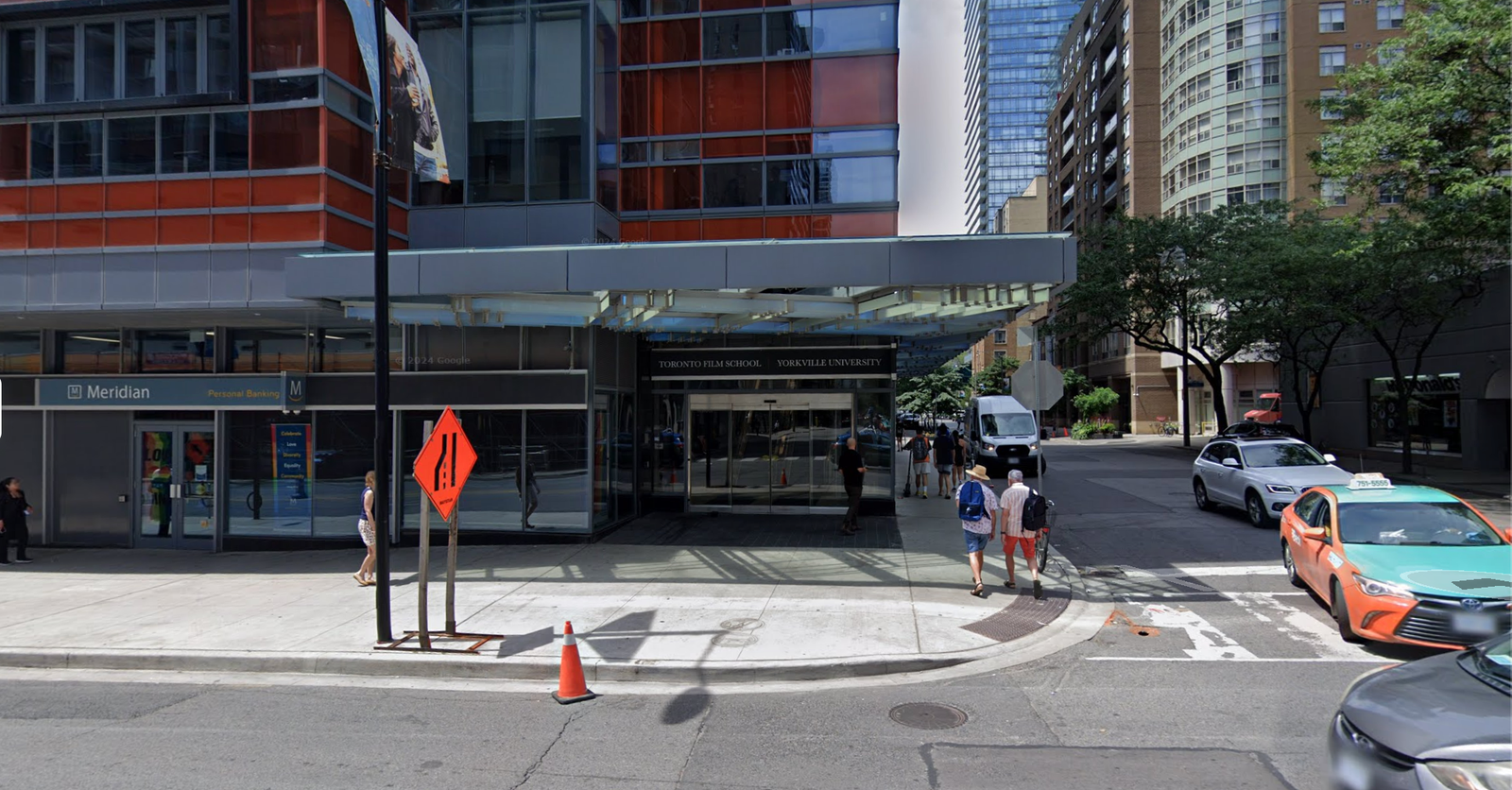
The university's model is deliberately different from a traditional research university: programs are career-focused and practice-driven, class sizes are small, admissions are rolling, and there are four intakes a year instead of the usual one or two. Yorkville also shares ownership and its Toronto building with the Toronto Film School, so the campus has a creative, industry-connected atmosphere.
| University name | Yorkville University (Toronto campus) |
|---|---|
| Type | Private university (provincially authorised to grant degrees) |
| Founded | 2003 (Toronto campus site dates to 1928 as Radio College of Canada) |
| Toronto campus address | 2000 Steeles Ave W, Concord, ON L4K 4N1, Canada |
| Other campuses | Vancouver, BC (on-campus); Fredericton, NB (online) |
| DLI number (Ontario) | O19396019511 |
| Credentials | Bachelor's degrees (BBA, Bachelor of Interior Design) on campus; Master's degrees online |
| Intakes | January, April, July, October |
| Application | Direct online application (no ontariocolleges.ca / OUAC needed) |
Where is Yorkville University Toronto? Campus and location
The "Toronto" campus is technically located at 2000 Steeles Avenue West in Concord (City of Vaughan), right on Toronto's northern boundary — a few minutes from York University and the TTC's Line 1 subway extension (Pioneer Village station area), which connects you to downtown Toronto in roughly 40–50 minutes. In practice, students live across North York, Vaughan, Brampton and downtown Toronto and commute by subway, YRT/Viva or TTC buses along Steeles.
This location matters for two reasons. First, you get access to Canada's largest job market — the Greater Toronto Area — which is a genuine advantage over small-city institutions when it comes to part-time work and post-graduation employment. Second, you should budget for Toronto-level living costs, which are among the highest in Canada (covered below).
Is Yorkville University public or private?
Let's answer the most-searched question directly: Yorkville University is a private university, not a public one. However — and this is the part most students get wrong — "private" does not mean unrecognised or ineligible for a study permit.
- Yorkville is a Designated Learning Institution (DLI). The Ontario campus DLI number is O19396019511, which is what you enter in your study-permit application.
- It is provincially authorised to grant degrees — in Ontario through ministerial consent under the province's quality-assurance process, and its Interior Design degree carries professional accreditation (CIDA) recognised across North America.
- Its on-campus degree programs are PGWP-eligible (full details and the honest fine print in the PGWP section below).
The genuine trade-off of "private" is financial, not legal: tuition is generally higher than a public college diploma, and Yorkville does not receive government operating grants. So the real question isn't "is it recognised?" — it's "does a private university degree fit my budget and goals better than a public college diploma?" This guide gives you the numbers to decide.
What is Yorkville University known for?
Three things stand out at the Toronto campus:
- Business (BBA) — a practitioner-taught Bachelor of Business Administration with specialisations such as Accounting, Project Management and Supply Chain Management, built for employability rather than academic theory.
- Interior Design — the Bachelor of Interior Design is the flagship. It is accredited by the Council for Interior Design Accreditation (CIDA) and recognised by ARIDO (Association of Registered Interior Designers of Ontario) and Interior Designers of Canada — credentials that matter if you want to become a registered interior designer in Ontario.
- Flexibility — four intakes a year, rolling admissions, fast offer letters, and accelerated timelines that can shorten a degree compared with a traditional university calendar. This is why Yorkville attracts many students who missed the September cycle at public institutions.
Programs at the Toronto campus
International students at the Toronto campus choose from on-campus degree programs (important for PGWP — see below). The core options:
| Program | Credential | Duration | Highlights |
|---|---|---|---|
| Bachelor of Business Administration (BBA) | Bachelor's degree | ~3–4 years (accelerated options) | Specialisations incl. Accounting, Project Management, Supply Chain Management |
| Bachelor of Interior Design (BID) | Bachelor's degree | 4 years | CIDA-accredited; ARIDO & IDC recognised; studio-based with internship |
Yorkville also offers online programs from its Fredericton virtual campus — including the Master of Arts in Counselling Psychology (MACP), Master of Education (MEd), MBA and BA in Interdisciplinary Studies. These are popular with Canadian residents and working professionals, but be careful: fully online programs do not qualify international students for a PGWP. If your goal is Canadian work experience after graduation, you must study on campus in Toronto or Vancouver.
Program menus and specialisations change, so always confirm your exact program and campus on the official Yorkville program page before applying.
Admission requirements for international students
Yorkville's admissions are rolling and comparatively fast, but the requirements are real:
- BBA: completion of Class 12 (10+2) from a recognised board, generally with around 55–60%+ for a competitive profile; mathematics background helps for Accounting.
- Bachelor of Interior Design: Class 12 completion; some intakes ask for a statement of intent, and creative aptitude is an asset (a portfolio strengthens the file even where not mandatory).
- Online Master's programs (MACP, MEd, MBA): a completed Bachelor's degree, typically with a B average (~70%/GPA 3.0); MACP additionally screens for suitability for counselling practice.
- All applicants need valid English-language proof (next section), a passport, and academic transcripts.
Yorkville does not use ontariocolleges.ca or OUAC — you apply directly through the university (or an authorised representative), which is one reason offer letters are quick.
English language requirements (IELTS, TOEFL, Duolingo, PTE)
As a general guide for recent intakes:
| Program level | Typical minimum (confirm per program) |
|---|---|
| Bachelor's (BBA, BID) | IELTS 6.0–6.5 overall (commonly no band below 6.0), or TOEFL iBT / Duolingo / PTE / CAEL equivalents |
| Online Master's (MACP, MBA, MEd) | IELTS 7.0 or equivalent is the safe benchmark, especially for MACP |
If your score is borderline, speak to a counsellor before booking a retest — accepted tests, minimums and waiver rules (for example, prior education in English) change by program and intake, and Yorkville evaluates some profiles case by case.
Tuition fees for international students
As a private university, Yorkville's fees sit above public college diplomas but below many big-name university degrees. Broad guide for recent Toronto-campus intakes:
- BBA: roughly CAD $19,000–$24,000+ per year for international students, varying by specialisation and course load (accelerated schedules front-load more credits, and cost, per year).
- Bachelor of Interior Design: roughly CAD $20,500–$24,000+ per year, plus materials, software and studio supplies that design students should budget separately.
- Online Master's programs: priced per course/credit; an MBA totals roughly CAD $30,000+ across the program.
Add an application fee, textbooks/digital resources, and mandatory health insurance. Tuition is charged per course at Yorkville, so your per-semester bill depends on how many courses you take — a detail that catches many students out. Always verify the exact, current fee for your program and intake on the official Yorkville tuition page before paying any deposit; figures change year to year and per specialisation.
Cost of living in Toronto
Here's the honest part most agents skip: the Toronto area is one of Canada's most expensive regions. Realistic monthly budgeting:
| Item | Approximate monthly cost (CAD) |
|---|---|
| Shared room / basement (Vaughan, North York, Brampton) | $700–$1,100 |
| Private condo room / studio closer to downtown | $1,300–$2,200+ |
| Food / groceries | $300–$500 |
| TTC/YRT transit pass | $100–$160 |
| Phone & miscellaneous | $150–$250 |
A realistic full-year living budget is roughly CAD $18,000–$22,000, and IRCC's proof-of-funds requirement (beyond first-year tuition) has risen in recent years — confirm the current figure on the IRCC website when you apply. Yorkville has no traditional on-campus residence at Steeles Avenue; students arrange off-campus housing, so start your search 2–3 months before arrival.
Scholarships & financial aid
Yorkville offers entrance awards and bursaries, and partner/agent channels sometimes carry additional tuition grants for specific intakes. Amounts are typically modest compared with public-university entrance scholarships — usually partial tuition credits rather than full rides — and eligibility changes each cycle. Check the current Yorkville scholarships page (and ask your counsellor what is live for your intake) rather than relying on any fixed number you see online.
Intakes and application deadlines
One of Yorkville's biggest practical advantages: four intakes a year — January, April, July and October — with rolling admissions. If you missed the September rush at public colleges and universities, Yorkville is one of the few degree-granting options that lets you start within months instead of waiting a full year.
Apply 4–6 months before your intended start to leave comfortable time for the offer letter, tuition deposit, GIC and study-permit processing. Popular intakes (January especially) fill earlier for Indian applicants.
PGWP eligibility — the honest answer
This is the section to read twice, because PGWP rules changed significantly from 1 November 2024.
- Yorkville's on-campus degree programs in Toronto and Vancouver are PGWP-eligible: graduates who studied full-time on campus can apply for a Post-Graduation Work Permit of up to three years.
- Here's the key advantage over college diplomas: under the post-2024 rules, the field-of-study (CIP code) restriction applies to college diploma and certificate graduates — but NOT to Bachelor's, Master's or doctoral degree graduates. Because Yorkville's Toronto programs are Bachelor's degrees, graduates are exempt from the CIP-code list that has disqualified many college programs. A Yorkville BBA or BID graduate does not need to worry about whether "business" is on IRCC's eligible field list — degree graduates are exempt from that rule.
- The critical conditions: you must study on campus (fully online study does not count toward PGWP for international students), maintain full-time status, and graduate. And as always, the final decision rests with IRCC, and PGWP rules can change — verify the current policy on the IRCC website at the time you apply.
In short: for PGWP purposes, a private university degree from Yorkville currently stands on stronger regulatory ground than many public college diplomas. That is a nuance most students — and many agents — miss.
Work while studying & spouse open work permit
As a DLI-enrolled full-time student, you can work off campus under standard study-permit conditions — currently up to 24 hours per week during academic sessions and full-time during scheduled breaks (confirm the current limit with IRCC, as this rule has been revised in recent years). Being on Toronto's doorstep genuinely helps here: retail, warehousing, hospitality and office part-time roles are far more plentiful in the GTA than in small college towns.
On the Spouse Open Work Permit (SOWP): since 2024, spouses of most Bachelor's-level students are not eligible for an open work permit — that benefit is now limited mainly to spouses of Master's, doctoral and certain professional-degree students. If bringing your spouse on an open work permit is central to your plan, discuss the current rules with a counsellor before choosing a Bachelor's program at any institution, Yorkville included.
Careers and industry connections
Yorkville's programs are taught largely by industry practitioners, and both Toronto programs are built around employability: the BID includes internship/studio components and prepares students toward the NCIDQ professional pathway, while BBA specialisations map to defined job families (project coordination, accounting support, supply-chain operations). Career services support resumes, interview prep and job-search strategy.
The honest caveat: as a smaller private university, Yorkville doesn't carry the on-campus recruiting machinery of a large public university. Your outcomes will depend heavily on your own networking, internships and part-time experience — which the GTA location makes very possible, but not automatic.
Student life & housing
The Steeles Avenue campus is modern, compact and shared with Toronto Film School students, giving it a creative, diverse energy — Yorkville's community includes students from 35+ countries. There's no sprawling campus lifestyle here: think professional-school environment rather than a traditional university quad. Most students build their social life across the GTA — and with Toronto's Indian, Punjabi and international communities among the largest in Canada, settling in is easier than in most Canadian cities. Housing is off-campus; Vaughan, North York and Brampton are the most common student areas near the campus transit lines.
How to apply to Yorkville University Toronto
You can apply directly to Yorkville, but the smartest route is to apply through the Apply Study Visa portal — because our certified counsellors review and submit your application for you, completely free. Here's how it works:
- Select your program on our portal. Browse Yorkville University's Toronto programs (BBA specialisations or the Bachelor of Interior Design), compare fees and intakes side by side, and run a free eligibility check to confirm you actually qualify before you spend a rupee.
- Submit your application with documents online. Upload your Class 12 / degree transcripts, English test result (IELTS/PTE/TOEFL/Duolingo), passport and any program-specific documents straight into your portal dashboard — no courier, no email chains.
- Our expert team double-checks everything. A certified counsellor personally verifies your documents, marks, English scores, SOP and program fit against Yorkville's current requirements — catching the small errors (wrong intake, missing document, borderline score) that get direct applications delayed or rejected.
- We submit your application to the university — for free. Apply Study Visa charges you nothing for application filing; you receive your Letter of Acceptance (Yorkville's offers are typically fast) and track every status update in your dashboard.
- We guide you to the study permit. Once your LOA arrives, our team helps you pay the tuition deposit, open your GIC, prepare your SOP and financial documents, and file your study permit using DLI O19396019511 — with visa assistance from the same team that has placed 27,000+ students.
Why not just apply directly? You can — but a rejected or delayed application costs you a full intake. With Apply Study Visa, an expert checks your file before the university sees it, at zero extra cost, and you get admission, GIC, visa and even air-ticket support under one roof. Check your eligibility for Yorkville University free →
So, is Yorkville University Toronto good?
For the right student — yes, with clear eyes. Yorkville makes the most sense if you: (a) want a degree rather than a diploma (which now carries a real PGWP advantage), (b) need a January, April, July or October start instead of waiting for September, (c) want to study in the Toronto job market, and (d) can afford private-university tuition plus GTA living costs. The CIDA-accredited Interior Design degree in particular is a genuinely strong, professionally recognised credential.
It's a weaker fit if your priority is minimum total cost (a public college diploma is cheaper — though check its CIP/PGWP status carefully), prestige rankings, or a traditional campus experience. Do the program-level homework, verify current fees and PGWP rules, and Yorkville is a credible, recognised, degree-granting option for international students.
This guide is for general information only and reflects details available as of July 2026. Program availability, fees, admission, work-hour and PGWP rules change frequently — always verify the latest information on Yorkville University's official website and the IRCC website before applying. Final study-permit and PGWP decisions are made by Immigration, Refugees and Citizenship Canada (IRCC).